Calon Arang
by Rangkuman 100 Cerita Rakyat Indonesia

Calon Arang and the Wise Empu
Once upon a time, in a kingdom, there was a witch. Her name was Calon Arang. She lived far away in a dark house. Calon Arang was not nice. She was mean. She was very mean. She did not like people. She wanted to be alone. She was often angry.
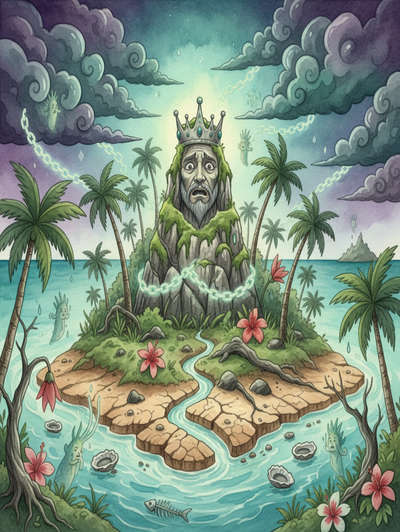
One day, Calon Arang was very angry. She used dark magic. Her dark magic went into the kingdom. It was a bad spell. People felt tired. People felt very tired. People felt sad. The kingdom was not happy. The dark magic was bad. It made people feel sick. It made the sun hide.
A wise man heard about this. His name was Empu Bharada. He was kind. He was very kind. He was smart. He wanted to help. Empu Bharada went to the kingdom. He wanted to stop the bad magic. He walked a long way. He walked through the forest.
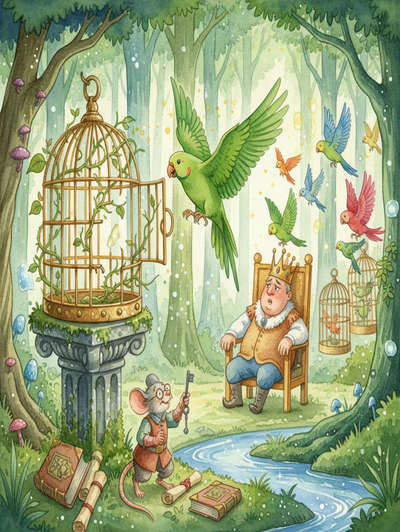
Empu Bharada had a special book. The book had wise words. The words shone with light. He also had a special knife. It was called a kris. The kris glowed with a soft light. He used the light and the wise words. He talked to Calon Arang. He was calm. He was very calm. His voice was gentle.
The light and the wise words were strong. Calon Arang's dark magic stopped. It stopped completely. She went away quietly. She went far away. The people felt better. They felt happy. They were happy again. The kingdom was safe. The sun came out. People smiled. Good thinking and kindness can stop bad things. Good thinking and kindness can stop bad things.
Original Story
Calon Arang Calon Arang menyebarkan wabah penyakit di kerajaan. Empu Bharada berhasil mengalahkannya dengan menggunakan kitab pusaka dan keris[6]. Pesan Moral: Kejahatan akan dikalahkan oleh kebijaksanaan.
Moral of the Story
Kejahatan akan dikalahkan oleh kebijaksanaan.
Characters

Calon Arang ⚔ antagonist
A woman of imposing stature, with a gaunt but powerful build. Her skin is likely dark from the tropical sun, possibly with a slightly greenish or ashen pallor hinting at her dark magic. Her movements are sharp and deliberate, reflecting her malevolent power.
Attire: Simple, dark-colored kain (sarong) wrapped around her lower body, possibly a dark kemben (bodice) or a loose, dark kebaya top. The fabric would be coarse cotton or linen, unadorned, reflecting her reclusive and dark nature rather than any royal affiliation. She might wear simple, heavy silver or bronze bracelets, unpolished and ancient-looking.
Wants: To exact revenge upon the kingdom for perceived slights and for her daughter's inability to find a suitor.
Flaw: Her overwhelming pride and reliance on dark magic, which ultimately cannot withstand true wisdom and spiritual power.
Begins as a powerful and vengeful witch, spreading destruction. Her arc culminates in her defeat and death at the hands of Empu Bharada, signifying the triumph of good over evil.
Malevolent, vengeful, powerful, reclusive, unforgiving.

Empu Bharada ★ protagonist
An elderly man, likely slender but with an inner strength that belies his age. His posture is upright and calm, reflecting his wisdom and spiritual discipline. His skin is weathered from age and exposure, consistent with an ascetic or scholar.
Attire: Simple, unadorned white or cream-colored kain (sarong) and a matching long-sleeved, loose-fitting baju (shirt) made of fine, breathable cotton or linen. His attire would be clean and modest, reflecting his spiritual devotion and detachment from worldly possessions. He might wear a simple, unadorned sash around his waist.
Wants: To protect the kingdom and its people from the plague and the dark magic of Calon Arang.
Flaw: Perhaps his advanced age, though his spiritual power compensates for any physical frailty.
Introduced as the wise figure capable of solving the kingdom's crisis. His arc is one of fulfilling his duty and demonstrating the triumph of wisdom over evil, remaining steadfast in his character.
Wise, calm, courageous, spiritually powerful, benevolent.
Locations

Kerajaan Daha
The royal palace of the ancient Javanese kingdom of Daha, likely featuring pendopo (open pavilions) with carved wooden pillars, tiered roofs, and possibly stone foundations, reflecting classical Javanese architecture. The atmosphere would be one of distress due to the plague.
Mood: Distressed, somber, fearful, as a plague spreads through its inhabitants.
The kingdom is afflicted by a devastating plague spread by Calon Arang.

Calon Arang's Dwelling/Lair
The dwelling of Calon Arang, a powerful witch, likely a secluded and ominous structure, perhaps a traditional Javanese house (rumah adat) but with a dark, unkempt, or magically altered appearance, possibly deep within a forest or isolated area. It would exude an eerie and malevolent aura.
Mood: Eerie, malevolent, powerful, dark, secretive.
This is where Calon Arang resides and likely performs her dark magic, from where she spreads the plague.

Empu Bharada's Retreat
The dwelling or meditation place of Empu Bharada, a wise and powerful sage, likely a simple, serene, and well-maintained traditional Javanese dwelling, perhaps a small hermitage or a modest house, possibly surrounded by nature, reflecting his wisdom and connection to spiritual power. It would be a place of calm and focus.
Mood: Serene, wise, calm, focused, spiritually charged.
Empu Bharada prepares to confront Calon Arang, using his sacred texts and keris.
Story DNA
Moral
Kejahatan akan dikalahkan oleh kebijaksanaan.
Plot Summary
Calon Arang, a powerful witch, spreads a deadly plague throughout the kingdom. To save the people, the wise Empu Bharada confronts her. Using a sacred book and a magical kris, Empu Bharada successfully defeats Calon Arang, ending the plague and restoring peace to the kingdom.
Themes
Emotional Arc
threat to resolution
Writing Style
Narrative Elements
Cultural Context
Calon Arang is a well-known figure in Balinese and Javanese folklore, often depicted as a powerful witch or sorceress. The story reflects ancient beliefs in magic, spiritual power, and the triumph of good over evil.
Plot Beats (5)
- Calon Arang, a powerful figure, is present in the kingdom.
- Calon Arang unleashes a devastating plague upon the kingdom.
- Empu Bharada, a wise and powerful individual, intervenes.
- Empu Bharada uses a sacred book and a kris to confront Calon Arang.
- Empu Bharada successfully defeats Calon Arang, ending the plague.