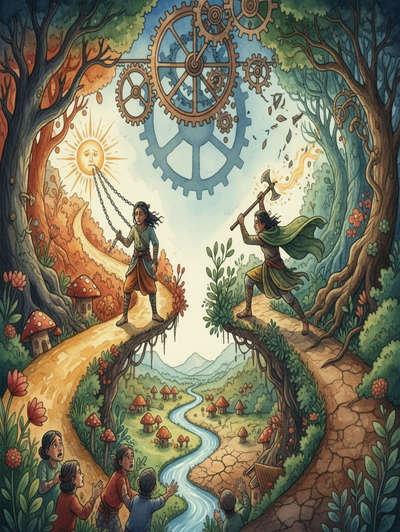
Legenda Gunung Wukir
by Balai Bahasa Surabaya

Ajisaka and the Magic Turban
Once, in Java, a mean king lived. His name was King Dewata. He hurt people. He took their food. He made them work hard.
Other men came to visit him. The king was not nice. He was very rude to them. He sent them away quickly.
Then, a man named Ajisaka came. He knew the king was not nice. He heard the stories about him.
The king saw Ajisaka. "I will hurt you!" he said. His voice was loud and angry.
Ajisaka had a smart idea. "You can have me," he said. "But first, give me land for my turban."
The king thought he was smart. "Okay," he agreed. He smiled a mean smile.
Ajisaka took off his turban. It was magic. It got longer and longer.
The king had to step back. The turban kept growing. It grew across the ground.
It grew all the way to the sea. The king walked back far away. He walked through fields and forests.
At the water's edge, the king slipped. He went into the sea. The water was cool and blue.
He turned into a white crocodile. He lived in the sea. He was not a king anymore.
Ajisaka said, "Now things will be fair." He smiled at the people. They were happy and safe.
He built a nice home on a mountain. He lived there peacefully. That is how the mountain got its name.
Being smart and kind can beat being mean and strong. So Ajisaka made the land happy and fair. The end.
Original Story
Legenda Gunung Wukir jak zaman Nabi Adam dan istrinya, Siti Hawa, di tanah Jawa sudah ada makhluk menyerupai kera. Manusia belum mengenal adat istiadat dan masih hidup sebagai makhluk liar. Seiring dengan terpecahnya Pulau Jawa menjadi beberapa daerah atau kawasan, makhluk tersebut tidak lagi mengenal siapa tuan mereka. Makhluk yang dinamai berkasaan itu akhirnya menjadi makhluk kanibal karena sering memangsa dan meminum darah manusia. Pada suatu ketika, datang utusan dari Tibet bernama Raam ke Jawa. Utusan pertama Tibet itu dibunuh. Pada. waktu lain, Tibet mengirim utusan kedua. Utusan kedua juga dibunuh. kerajaan Tibet tidak berhenti mengirim utusan, tetapi utusan ketiga dan keempat pun bernasib sama dengan Raam, Sesampai di tanah Jawa, mereka pun dibunuh, Hingga sampailah pada utusan kelima, yaitu Ajisaka. Pada saat Ajisaka datang, tanah Jawa berada di bawah kekuasaan Prabu Dewata Cengkar. Prabu Dewata Cengkar adalah raja yang bengis dan berwatak kanibal. Ia masih melakukan kesenangan-kesenangan yang tidak beradab seperti makan dan minum darah manusia. Ia berkeyakinan bahwa sifat dan sikapnya tersebut terjadi karena pengaruh roh-roh jahat zaman dulu. Sebelum berangkat ke tanah Jawa, Ajisaka sudah mengetahui keadaannya berdasarkan pengalaman-pengalaman utusan sebelumnya. Ajisaka juga sudah mengetahui sifat-sifat buruk Dewata Cengkar. "Hai orang asing, siapakah engkau dan dari mana asalmu,” kata Prabu Dewata Cengkar menyambut tamunya. "Ampun Paduka. Hamba datang dari negeri nun jauh di seberang, Negeri Tibet, Paduka,” Ajisaka menjawab takzim. Belum selesai Ajisaka meneruskan jawabannya, Dewata Cengkar menyela "Tibet?! Apakah kau sudah mendengar bagaimana nasib teman-temanmu terdahulu hah?" "Ampun, Paduka. Hamba sudah mengetahui nasib teman-teman hamba yang diutus kemari,” jawab Ajisaka tetap menunduk. "Hmmm...lantas, apakah kau ingin menyusul mereka?” Prabu Dewata Cengkar menggertak congkak. ”Ampun, Paduka. Hamba tidak bermaksud demikian. Kedatangan hamba ke sini hanya ingin menyampaikan pesan. "Apakah kau tahu persita di negeri ini? Setiap orang asing yang datang harus dibunuh!” ”Silakan Paduka bunuh hamba, tapi izinkan dulu hamba menyampaikan pesan...” ”Kau hanya mengulur-ulur waktu saja.” Akhirnya, setelah terjadi perdebatan alot, Ajisaka berkata, "Wahai Prabu Dewata Cengkar, Prabu boleh membunuh dan memakan hamba, tetapi hamba ingin mengajukan satu syarat.” 59 "Heh, syarat? Belum ada yang pemah mengajukan syarat apa pun kepadaku!” Dewata Cengkar mulai murka. Akan tetapi, sejenak kemudian ia berkata, "Baik, apa syarat yang ingin kau minta? Aku sudah tidak sabar untuk menjadikanmu makan siangku. Hahahaha.” "Hamba hanya minta satu jengkal tanah di daerah kekuasaanmu ini,” jawab Ajisaka. “Biarlah sejengkal tanah itu jadi penanda bahwa hamba pemah datang kemari. Itu saja.” “Tanah? Sejengkal? Kalau itu buat mengubur tulang-tulangmu, ambillah seberapa yang kau mau.” "Hamba ingin mengukur luas tanah itu menggunakan surban yang hamba pakai ini. Caranya, hamba akan bentangkan surban ini dihadapan Paduka, dan setiap kali surban ini hamba bentangkan, Paduka harus mundur sesuai dengan bentangan surban,” terang Ajisaka. ”Kau mau mengajakku bermain-main?” Dewata Cengkar gusar. ”Ampun Paduka. Ini hanya untuk menunjukkan bahwa paduka adalah raja yang berani dan bersifat ksatria,” bujuk Ajisaka. Akhirnya, syarat itu disetujui oleh Prabu Dewata Cengkar. Prabu Dewata Cengkar menganggap syarat itu mudah. Ia sudah tidak sabar ingin menghabisi Ajisaka. Ajisaka mulai membuka surbannya, dan setiap kali surban dibuka, Prabu Dewata Cengkar mundur sejengkal. Surban dibuka lagi, Dewata Cengkar mundur sejengkal lagi. Demikian Ajisaka terus melakukan hingga akhirnya tiba di pantai selatan Pulau Jawa. Karena kesaktian dan kecerdikannya, ia dapat membawa Prabu Dewata Cengkar sampai ke laut selatan hanya dengan menggunakan sehelai kain ikat kepala. Ajisaka merasa bahwa upayanya tersebut juga merupakan bukti kekuasaan dan kehendak Sang Hyang Widi Wasesa. Akhirnya, tanpa sadar Prabu Dewata Cengkar sudah berada di bibir jurang tepi laut, Satu kibasan terakhir surban Ajisaka menyebabkan Prabu Dewata Cengkar jatuh terperosok ke laut dan akhirnya tenggelam. Selanjutnya dikisahkan bahwa Prabu Dewata Cengkar berubah menjadi buaya putih yang menguasai daerah di sekitar pantai tersebut. Pada saat itulah Ajisaka berikrar dan mengatakan bahwa tenggelamnya Dewata Cengkar merupakan akhir dari sebuah ketamakan dan kerakusan, akhir dari sebuah ketidakbaikan. Sejak saat itu, segala ketidakbaikan selalu dibuang ke laut selatan. Tidak lama kemudian, Ajisaka membangun sebuah pertapaan berupa candi di Gunung Arjuna. Di tempat itu dibangun juga sebuah padepokan yang dinamakan Indrakila, sebuah Pesanggrahan Mentalamariyem dan Semar Kiai Badranaya. Menurut kepercayaan, puncak Gunung Arjuna sebenarnya terpenggal dan penggalannya adalah sebuah gunung yang diberi nama Gunung Ukir yang berlokasi di perbatasan antara Singosari dan Kediri. Disebut Gunung Ukir karena gunung batu yang dipindahkan oleh para punakawan tersebut oleh Tunggul Wulung diganden (diukir dan ditatah) untuk diambil batu-batunya. Beberapa orang menyebutnya sebagai mbah watu ganden (ukir atau pahat). Batu-batu yang diganden diisi yoni oleh Tunggul Wulung sebelum dibawa oleh para punakawan ke tempat- tempat tain untuk pembuatan candi. Sejak saat itulah gunung batu tersebut diberi nama Gunung Ukir yang berarti gunung yang diukir. 60
Moral of the Story
Cunning and wisdom can overcome brute force and tyranny, leading to justice and the establishment of a better order.
Characters

Ajisaka ★ protagonist
None explicitly mentioned, but implied to be physically capable and astute.
Attire: A turban (surban) which he uses as a magical tool.
Clever, brave, strategic, respectful (initially feigned).

Prabu Dewata Cengkar ⚔ antagonist
None explicitly mentioned, but implied to be imposing and fearsome. Transforms into a white crocodile.
Attire: Royal attire, befitting a king.
Cruel, cannibalistic, arrogant, easily angered, overconfident.

Raam ○ minor
None mentioned.
Attire: None mentioned.
Unlucky.

Tunggul Wulung ○ minor
None mentioned.
Attire: None mentioned.
Skilled, mystical (imbues yoni into stones).

Semar Kiai Badranaya ○ minor
None explicitly mentioned, but known from Javanese mythology as a plump, wise, and somewhat grotesque figure.
Attire: None explicitly mentioned, but typically wears simple, traditional Javanese clothing.
Wise, guardian-like (implied by his association with the padepokan).
Locations

Land of Java
A land where ape-like creatures roamed before humans knew customs, later becoming cannibalistic. It is under the tyrannical rule of Prabu Dewata Cengkar.
Mood: Dangerous, wild, uncivilized, under oppressive rule.
The setting for Ajisaka's arrival and his confrontation with Prabu Dewata Cengkar.

Prabu Dewata Cengkar's Court/Palace
The place where Ajisaka first meets Prabu Dewata Cengkar and proposes his 'one span of land' challenge.
Mood: Tense, arrogant, dangerous, formal yet barbaric.
Ajisaka's initial confrontation and negotiation with the king.

Southern Coast of Java
The edge of a cliff overlooking the sea, where Ajisaka leads Prabu Dewata Cengkar with his turban.
Mood: Dramatic, climactic, perilous, vast.
The climax where Prabu Dewata Cengkar is pushed into the sea and transforms into a white crocodile.

Mount Arjuna
A mountain where Ajisaka later builds a hermitage (candi) and a spiritual retreat (padepokan Indrakila). Its peak is believed to have been severed.
Mood: Spiritual, peaceful, sacred, historical.
Ajisaka establishes a place of worship and learning after defeating Dewata Cengkar.

Mount Ukir
A stone mountain located on the border between Singosari and Kediri, believed to be the severed peak of Mount Arjuna. Its stones were carved and shaped by Tunggul Wulung.
Mood: Ancient, mystical, sculpted, significant.
The origin of the mountain's name and its connection to the creation of temples.
Story DNA
Moral
Cunning and wisdom can overcome brute force and tyranny, leading to justice and the establishment of a better order.
Plot Summary
In ancient Java, a tyrannical, cannibalistic king named Prabu Dewata Cengkar rules, having killed previous envoys from Tibet. The fifth envoy, Ajisaka, arrives, aware of the danger. He cleverly challenges the king, offering himself as food if the king grants him a piece of land measured by his turban. The arrogant king agrees, but Ajisaka's magical turban extends endlessly, forcing the king to retreat across the land until he falls into the southern sea, transforming into a white crocodile. Ajisaka establishes a new order, and the story concludes with the origin of Gunung Wukir, a mountain carved from Gunung Arjuna, symbolizing the new era.
Themes
Emotional Arc
suffering to triumph
Writing Style
Narrative Elements
Cultural Context
This legend is a foundational myth in Javanese culture, often associated with the origin of the Javanese script (Aksara Jawa) and the establishment of a civilized order after a period of chaos and tyranny. The figure of Ajisaka is a culture hero.
Plot Beats (13)
- In ancient Java, ape-like cannibals roam, and later, the land is ruled by the cannibalistic King Dewata Cengkar.
- Previous envoys from Tibet are killed by Dewata Cengkar upon arrival in Java.
- Ajisaka, the fifth envoy, arrives in Java, fully aware of the king's brutal nature and the fate of his predecessors.
- Ajisaka confronts Dewata Cengkar, who threatens to kill and eat him.
- Ajisaka cleverly proposes a condition: he will allow himself to be eaten if the king grants him a piece of land measured by his turban.
- Dewata Cengkar, arrogant and underestimating Ajisaka, agrees to the condition, eager to consume him.
- Ajisaka begins to unroll his magical turban, and with each stretch, the king is forced to retreat a corresponding distance.
- The turban's magical extension leads Dewata Cengkar across the land, all the way to the southern coast of Java.
- At the cliff's edge, the final unfurling of the turban causes Dewata Cengkar to fall into the sea.
- Dewata Cengkar transforms into a white crocodile, becoming the ruler of the southern sea.
- Ajisaka declares this the end of greed and evil, establishing a new era of justice.
- Ajisaka builds a hermitage and padepokan, including Indrakila and Pesanggrahan Mentalamariyem, on Gunung Arjuna.
- A part of Gunung Arjuna is said to have been carved (diukir) by Tunggul Wulung and moved by punakawan to become Gunung Wukir, explaining its name and origin.