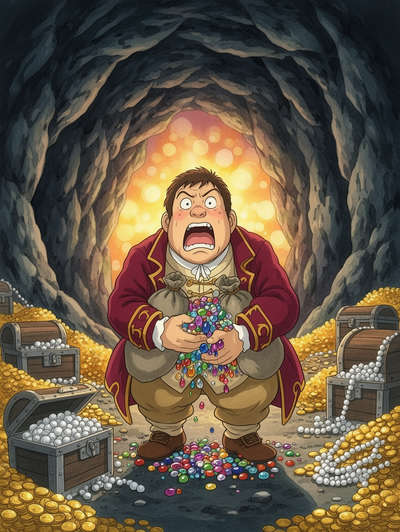
The griffin
by Brothers Grimm

Hans and the Golden Apples
Once upon a time, a princess was sick. Her father, the King, was very sad. "Who can help my girl?" he asked. A wise bird came. "A special apple can help," it said. The King told everyone in the land.
A farmer had three sons. The first brother put apples in a basket. He walked to the castle. On the road, a little man stood. He was small. He wore iron clothes. "What is in your basket?" he asked. "Frogs' legs!" said the first brother. He was rude. He did not smile. He got to the King. He opened the basket. No apples! Only frogs' legs. "Go home," said the King.
The second brother tried too. He took apples in a basket. He met the little man. "What is in your basket?" he asked. "Straw!" said the second brother. He was rude too. At the castle, he opened the basket. No apples. Only straw. "Go home," said the King.
Then Hans wanted to go. Hans was the youngest brother. "You are too small," said his father. "You are too small," said his brothers. But Hans was brave. "I can try!" he said. He put apples in his basket. He walked down the road. The little man stood there. He smiled. He always smiled. "What is in your basket?" he asked. "Apples for the princess!" said Hans. "I want to help!" The little man smiled. "Good boy. Your apples will shine like gold."
Hans walked to the castle. The King let him in. Hans opened his basket. The apples were golden! They shone like the sun. The princess ate one apple. She sat up. She ate one more. She jumped out of bed! "I am well!" she said. The King was happy. But then the King wanted more. "Now build me a boat," he said. "It must go fast on land."
Hans went to the little man. The little man smiled. "Here, take this," he said. He gave Hans a magic hammer. Hans hit the wood. Bang, bang, bang! He built a boat with wheels! It rolled on the grass. It was so fast! The King was very surprised.
But the King wanted more. "Now watch my one hundred rabbits," he said. "Do not lose any!"
The little man gave Hans a whistle. It was a magic whistle. Hans blew it. Whee! All the rabbits came back. They hopped around him. They sat by his feet. Not one rabbit was lost. The princess laughed and clapped her hands.
The King said one more thing. "Bring me a griffin feather." The griffin was very big! Hans was brave. He walked far, far away.
Hans met a tall man. He stood by a lake. The tall man was sad. "I carry people all day," he said. "How can I stop? Ask the griffin!" "I will help," said Hans. Then Hans met a man by a castle. "I lost my key," said the man. "Ask the griffin!" "I will help," said Hans.
Hans came to the griffin's house. The griffin was not home. The griffin's wife was kind. "Shh," she said. "Hide under the bed." Hans hid. The griffin came home. He was big. He lay down. He fell asleep. He snored so loud. RRRR! RRRR! The griffin talked in his sleep. "The key is under the big rock," he said. "The tall man must put someone down." Hans pulled one feather—very gently. Then he ran away fast!
Hans went back to the man. "Your key is under the big rock!" The man looked. He found it! "Thank you, Hans!" he said. He gave Hans presents. Then Hans told the tall man how to be free. "Thank you, Hans!" said the tall man. He gave Hans presents too. Hans had a big bag of gifts!
Hans walked to the King. He gave him the feather. The King saw all the presents too. The King smiled at last. "You did it!" he said. Hans and the princess were best friends. They lived in the big castle. And they are happy every day. The end.
Original Story
The griffin A fairy tale by the Brothers Grimm There was once upon a time a King, but where he reigned and what he was called, I do not know. He had no son, but an only daughter who had always been ill, and no doctor had been able to cure her. Then it was foretold to the King that his daughter should eat herself well with an apple. So he ordered it to be proclaimed throughout the whole of his kingdom, that whosoever brought his daughter an apple with which she could eat herself well, should have her to wife, and be King. This became known to a peasant who had three sons, and he said to the eldest, "Go out into the garden and take a basketful of those beautiful apples with the red cheeks and carry them to the court; perhaps the King's daughter will be able to eat herself well with them, and then thou wilt marry her and be King." The lad did so, and set out. When he had gone a short way he met a little iron man who asked him what he had there in the basket, to which replied Uele, for so was he named, "Frogs' legs." On this the little man said, "Well, so shall it be, and remain," and went away. At length Uele arrived at the palace, and made it known that he had brought apples which would cure the King's daughter if she ate them. This delighted the King hugely, and he caused Uele to be brought before him; but, alas! when he opened the basket, instead of having apples in it he had frogs' legs which were still kicking about. On this the King grew angry, and had him driven out of the house. When he got home he told his father how it had fared with him. Then the father sent the next son, who was called Seame, but all went with him just as it had gone with Uele. He also met the little iron man, who asked what he had there in the basket. Seame said, "Hogs' bristles," and the iron man said, "well, so shall it be, and remain." When Seame got to the King's palace and said he brought apples with which the King's daughter might eat herself well, they did not want to let him go in, and said that one fellow had already been there, and had treated them as if they were fools. Seame, however, maintained that he certainly had the apples, and that they ought to let him go in. At length they believed him, and led him to the King. But when he uncovered the basket, he had but hogs' bristles. This enraged the King most terribly, so he caused Seame to be whipped out of the house. When he got home he related all that had befallen him, then the youngest boy, whose name was Hans, but who was always called Stupid Hans, came and asked his father if he might go with some apples. "Oh!" said the father, "thou wouldst be just the right fellow for such a thing! If the clever ones can't manage it, what canst thou do?" The boy, however, did not believe him, and said, "Indeed, father, I wish to go." - "Just get away, thou stupid fellow, thou must wait till thou art wiser," said the father to that, and turned his back. Hans, however, pulled at the back of his smock- frock and said, "Indeed, father, I wish to go." - "Well, then, so far as I am concerned thou mayst go, but thou wilt soon come home again!" replied the old man in a spiteful voice. The boy, however, was tremendously delighted and jumped for joy. "Well, act like a fool! thou growest more stupid every day!" said the father again. Hans, however, did not care about that, and did not let it spoil his pleasure, but as it was then night, he thought he might as well wait until the morrow, for he could not get to court that day. All night long he could not sleep in his bed, and if he did doze for a moment, he dreamt of beautiful maidens, of palaces, of gold, and of silver, and all kinds of things of that sort. Early in the morning, he went forth on his way, and directly afterwards the little shabby-looking man in his iron clothes, came to him and asked what he was carrying in the basket. Hans gave him the answer that he was carrying apples with which the King's daughter was to eat herself well. "Then," said the little man, "so shall they be, and remain." But at the court they would none of them let Hans go in, for they said two had already been there who had told them that they were bringing apples, and one of them had frogs' legs, and the other hogs' bristles. Hans, however, resolutely maintained that he most certainly had no frogs' legs, but some of the most beautiful apples in the whole kingdom. As he spoke so pleasantly, the door-keeper thought he could not be telling a lie, and asked him to go in, and he was right, for when Hans uncovered his basket in the King's presence, golden-yellow apples came tumbling out. The King was delighted, and caused some of them to be taken to his daughter, and then waited in anxious expectation until news should be brought to him of the effect they had. But before much time had passed by, news was brought to him: but who do you think it was who came? it was his daughter herself! As soon as she had eaten of those apples, she was cured, and sprang out of her bed. The joy the King felt cannot be described! but now he did not want to give his daughter in marriage to Hans, and said he must first make him a boat which would go quicker on dry land than on water. Hans agreed to the conditions, and went home, and related how it had fared with him. Then the father sent Uele into the forest to make a boat of that kind. He worked diligently, and whistled all the time. At mid-day, when the sun was at the highest, came the little iron man and asked what he was making? Uele gave him for answer, "Wooden bowls for the kitchen." The iron man said, "So it shall be, and remain." By evening Uele thought he had now made the boat, but when he wanted to get into it, he had nothing but wooden bowls. The next day Seame went into the forest, but everything went with him just as it had done with Uele. On the third day Stupid Hans went. He worked away most industriously, so that the whole forest resounded with the heavy strokes, and all the while he sang and whistled right merrily. At mid-day, when it was the hottest, the little man came again, and asked what he was making? "A boat which will go quicker on dry land than on the water," replied Hans, " and when I have finished it, I am to have the King's daughter for my wife." - "Well," said the little man, "such an one shall it be, and remain." In the evening, when the sun had turned into gold, Hans finished his boat, and all that was wanted for it. He got into it and rowed to the palace. The boat went as swiftly as the wind. The King saw it from afar, but would not give his daughter to Hans yet, and said he must first take a hundred hares out to pasture from early morning until late evening, and if one of them got away, he should not have his daughter. Hans was contented with this, and the next day went with his flock to the pasture, and took great care that none of them ran away. Before many hours had passed came a servant from the palace, and told Hans that he must give her a hare instantly, for some visitors had come unexpectedly. Hans, however, was very well aware what that meant, and said he would not give her one; the King might set some hare soup before his guest next day. The maid, however, would not believe in his refusal, and at last she began to get angry with him. Then Hans said that if the King's daughter came herself, he would give her a hare. The maid told this in the palace, and the daughter did go herself. In the meantime, however, the little man came again to Hans, and asked him what he was doing there? He said he had to watch over a hundred hares and see that none of them ran away, and then he might marry the King's daughter and be King. "Good," said the little man, "there is a whistle for thee, and if one of them runs away, just whistle with it, and then it will come back again." When the King's daughter came, Hans gave her a hare into her apron; but when she had gone about a hundred steps with it, he whistled, and the hare jumped out of the apron, and before she could turn round was back to the flock again. When the evening came the hare-herd whistled once more, and looked to see if all were there, and then drove them to the palace. The King wondered how Hans had been able to take a hundred hares to graze without losing any of them; he would, however, not give him his daughter yet, and said he must now bring him a feather from the Griffin's tail. Hans set out at once, and walked straight forwards. In the evening he came to a castle, and there he asked for a night's lodging, for at that time there were no inns. The lord of the castle promised him that with much pleasure, and asked where he was going? Hans answered, "To the Griffin." - "Oh! to the Griffin! They tell me he knows everything, and I have lost the key of an iron money-chest; so you might be so good as to ask him where it is." - "Yes, indeed," said Hans, "I will do that." Early the next morning he went onwards, and on his way arrived at another castle in which he again stayed the night. When the people who lived there learnt that he was going to the Griffin, they said they had in the house a daughter who was ill, and that they had already tried every means to cure her, but none of them had done her any good, and he might be so kind as to ask the Griffin what would make their daughter healthy again? Hans said he would willingly do that, and went onwards. Then he came to a lake, and instead of a ferry-boat, a tall, tall man was there who had to carry everybody across. The man asked Hans whither he was journeying? "To the Griffin," said Hans. "Then when you get to him," said the man, "just ask him why I am forced to carry everybody over the lake." - "Yes, indeed, most certainly I'll do that," said Hans. Then the man took him up on his shoulders, and carried him across. At length Hans arrived at the Griffin's house, but the wife only was at home, and not the Griffin himself. Then the woman asked him what he wanted? Thereupon he told her everything;--that he had to get a feather out of the Griffin's tail, and that there was a castle where they had lost the key of their money-chest, and he was to ask the Griffin where it was?--that in another castle the daughter was ill, and he was to learn what would cure her?--and then not far from thence there was a lake and a man beside it, who was forced to carry people across it, and he was very anxious to learn why the man was obliged to do it. Then said the woman, "But look here, my good friend, no Christian can speak to the Griffin; he devours them all; but if you like, you can lie down under his bed, and in the night, when he is quite fast asleep, you can reach out and pull a feather out of his tail, and as for those things which you are to learn, I will ask about them myself." Hans was quite satisfied with this, and got under the bed. In the evening, the Griffin came home, and as soon as he entered the room, said, "Wife, I smell a Christian." - "Yes," said the woman, "one was here to-day, but he went away again;" and on that the Griffin said no more. In the middle of the night when the Griffin was snoring loudly, Hans reached out and plucked a feather from his tail. The Griffin woke up instantly, and said, "Wife, I smell a Christian, and it seems to me that somebody was pulling at my tail." His wife said, "Thou hast certainly been dreaming, and I told thee before that a Christian was here to-day, but that he went away again. He told me all kinds of things that in one castle they had lost the key of their money-chest, and could find it nowhere." - "Oh! the fools!" said the Griffin; "the key lies in the wood- house under a log of wood behind the door." - "And then he said that in another castle the daughter was ill, and they knew no remedy that would cure her." - "Oh! the fools!" said the Griffin; "under the cellar-steps a toad has made its nest of her hair, and if she got her hair back she would be well." - "And then he also said that there was a place where there was a lake and a man beside it who was forced to carry everybody across." - "Oh, the fool!" said the Griffin; "if he only put one man down in the middle, he would never have to carry another across." Early the next morning the Griffin got up and went out. Then Hans came forth from under the bed, and he had a beautiful feather, and had heard what the Griffin had said about the key, and the daughter, and the ferry-man. The Griffin's wife repeated it all once more to him that he might not forget it, and then he went home again. First he came to the man by the lake, who asked him what the Griffin had said, but Hans replied that he must first carry him across, and then he would tell him. So the man carried him across, and when he was over Hans told him that all he had to do was to set one person down in the middle of the lake, and then he would never have to carry over any more. The man was hugely delighted, and told Hans that out of gratitude he would take him once more across, and back again. But Hans said no, he would save him the trouble, he was quite satisfied already, and pursued his way. Then he came to the castle where the daughter was ill; he took her on his shoulders, for she could not walk, and carried her down the cellar-steps and pulled out the toad's nest from beneath the lowest step and gave it into her hand, and she sprang off his shoulder and up the steps before him, and was quite cured. Then were the father and mother beyond measure rejoiced, and they gave Hans gifts of gold and of silver, and whatsoever else he wished for, that they gave him. And when he got to the other castle he went at once into the wood- house, and found the key under the log of wood behind the door, and took it to the lord of the castle. He also was not a little pleased, and gave Hans as a reward much of the gold that was in the chest, and all kinds of things besides, such as cows, and sheep, and goats. When Hans arrived before the King, with all these things--with the money, and the gold, and the silver and the cows, sheep and goats, the King asked him how he had come by them. Then Hans told him that the Griffin gave every one whatsoever he wanted. So the King thought he himself could make such things useful, and set out on his way to the Griffin; but when he got to the lake, it happened that he was the very first who arrived there after Hans, and the man put him down in the middle of it and went away, and the King was drowned. Hans, however, married the daughter, and became King. * * * * *
Moral of the Story
Kindness, perseverance, and a good heart will ultimately lead to success and reward, while greed and deceit will lead to ruin.
Characters

Hans ★ protagonist
None explicitly mentioned, but implied to be an ordinary peasant boy.
Attire: A smock-frock (peasant's tunic) at the beginning, later acquires fine clothes and wealth.
Determined, kind, honest, clever (despite being called 'Stupid Hans').

The King ⚔ antagonist
None explicitly mentioned, but implied to be of regal stature.
Attire: Royal attire, crown (implied).
Demanding, initially delighted, then angry, greedy, ultimately foolish.

The King's Daughter ◆ supporting
Always ill, but cured by the apples, implying a sudden return to health and beauty.
Attire: Initially in bedclothes due to illness, later implied to wear fine dresses.
Passive due to illness, grateful after being cured.

The Little Iron Man ◆ supporting
Little, shabby-looking, dressed in iron clothes.
Attire: Iron clothes.
Mischievous, magical, literal-minded (granting wishes exactly as stated).

The Griffin ◆ supporting
A creature with the body of a lion and the head and wings of an eagle.
Attire: None, as a creature.
Perceptive (smells Christians), knowledgeable, easily tricked when asleep, devours humans.

The Griffin's Wife ◆ supporting
None explicitly mentioned, but implied to be a creature similar to the Griffin or a human woman married to him.
Attire: None explicitly mentioned, but implied to be domestic.
Helpful, cunning, protective (of Hans), understanding.

The Ferryman ◆ supporting
Tall, tall man, forced to carry everyone across the lake.
Attire: Simple, practical clothing suitable for a ferryman.
Burdened, desperate for release, grateful.
Locations

Royal Palace
The King's residence, where his daughter is ill and suitors bring apples. It has a grand entrance and a presence chamber where the King receives visitors.
Mood: initially hopeful, then frustrated and angry, finally joyful
The King's daughter is cured by Hans's apples; Hans brings back wealth and eventually marries the princess.

Forest
A wooded area where the brothers go to build the boat. For Hans, it resounds with the sound of his diligent work.
Mood: solitary, industrious for Hans, frustrating for his brothers
Hans successfully builds the boat that travels on land, while his brothers fail.

Lake with the Ferryman
A body of water where a tall man is forced to carry everyone across instead of a ferry-boat.
Mood: mysterious, burdensome for the ferryman, pivotal for Hans's journey
Hans learns the ferryman's curse and helps him break it; the King is drowned here.

The Griffin's House
The dwelling of the Griffin and his wife. It has a bed where the Griffin sleeps and Hans hides underneath.
Mood: eerie, dangerous, secretive, magical
Hans hides under the bed, plucks a feather, and overhears the Griffin's solutions to the various problems.
Story DNA
Moral
Kindness, perseverance, and a good heart will ultimately lead to success and reward, while greed and deceit will lead to ruin.
Plot Summary
A King offers his daughter's hand and kingdom to anyone who can cure her with an apple. The two elder, 'clever' brothers fail due to a magical trickster, but the youngest, 'Stupid Hans,' succeeds. The King, unwilling to honor his promise, sets Hans three impossible tasks: building a magical land-boat, herding 100 hares without loss, and retrieving a griffin's feather. With the help of the magical iron man, Hans completes the first two tasks. On his quest for the feather, Hans gathers information from the griffin to solve the problems of three strangers, earning rich rewards. Upon his return, Hans marries the princess and becomes King, while the greedy King attempts to visit the griffin himself and drowns.
Themes
Emotional Arc
underestimation to triumph
Writing Style
Narrative Elements
Cultural Context
Grimm's fairy tales often reflect societal norms and moral lessons prevalent in 19th-century Germany, including the 'rule of three' and the triumph of the underdog.
Plot Beats (16)
- King's daughter is ill; King offers her hand and kingdom to whoever cures her with an apple.
- Peasant's eldest son, Uele, attempts to bring apples but is tricked by a little iron man into carrying frogs' legs; he is banished.
- Peasant's second son, Seame, attempts the same, is tricked into carrying hogs' bristles, and is whipped away.
- Youngest son, Hans (Stupid Hans), despite his father's discouragement, sets out with apples and is blessed by the iron man.
- Hans successfully brings golden apples, cures the princess, but the King imposes a new task: build a boat that travels on land faster than on water.
- Uele and Seame fail at the boat task, producing only wooden bowls and bristles, respectively, due to the iron man's trick.
- Hans, with the iron man's blessing, builds the magical boat and presents it to the King.
- The King imposes a third task: herd 100 hares all day without losing any.
- Hans, aided by a magical whistle from the iron man, successfully herds the hares, even retrieving one taken by the princess.
- The King imposes a final, seemingly impossible task: bring a feather from a griffin's tail.
- On his journey, Hans encounters and promises to ask the griffin about a lost key, a sick daughter, and a ferryman's curse.
- Hans hides under the griffin's bed, overhears the griffin reveal the solutions to all problems, and plucks a feather.
- Hans returns, solving the ferryman's curse (by telling him to drop one person in the lake), curing the sick daughter (by removing a toad's nest from her hair), and finding the lost key (under a log).
- Hans receives rich rewards from the grateful people he helped.
- Hans returns to the King, who, upon hearing of the griffin's 'generosity,' attempts to visit the griffin himself, but is drowned by the now-free ferryman.
- Hans marries the princess and becomes King.