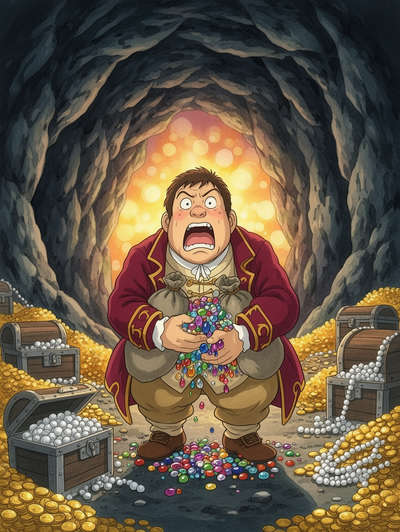
IRON JOHN
by Brothers Grimm

The Golden Boy and the Wild Man
One day, a King had a big forest. A strange thing lived inside it. The King's helpers went to look. They found a wild man in a pond. He was very big and brown. They put him in a cage. The cage was in the garden. The cage was big and strong.
The King had a little boy. The boy liked to play. He had a shiny golden ball. One day, the ball rolled away. It rolled into the cage!
"Give me my ball," said the boy.
"Open the door first," said the wild man. "Please, little friend."
The boy said, "I have no key."
"Under Mama's pillow," said the wild man.
The boy found the key. He opened the cage door. The wild man gave him the ball. "Come," said the wild man. "Come see the forest." The boy smiled. He went with the wild man. The trees were tall and green. They walked into the big forest.
The wild man showed him a pond. The water was bright and golden. "Do not put a thing in," he said.
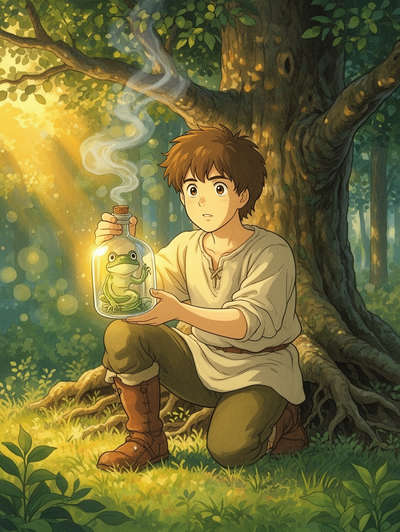
The boy sat by the pond. His finger hurt. He put it in the water. He took it out. His finger was gold! "Oh!" said the boy. "It is gold!"
The next day, a hair fell in. The hair turned gold too! "Look!" said the boy.
Then all his hair turned gold. It was very bright and shiny. The boy looked in the water. His golden hair shone like the sun. He laughed a little happy laugh.
The wild man came back. He saw the golden hair. He smiled. "You must go now," he said. "But if you need help, call me. My name is Iron John."
"Iron John," said the boy. He hid his golden hair. He waved and walked away.
The boy walked very far. He came to a new castle. A flower man lived there. "Can I help you?" said the boy. The flower man said yes. The boy helped him grow flowers. He always wore his little hat. He worked hard every day there.
One day, a big storm came. The wind was very loud. The rain was very hard. The castle needed help! The boy ran outside. He called out, "Iron John!" Iron John came. He had a big, strong horse. "Here, little friend," he said.
The boy rode the big horse. He was very brave. He helped all in the castle. He kept them safe from the storm. Then he gave the horse back. He put on his little hat. No one knew it was him!
The King had a big party. It was three days long! The Princess had three golden apples.
On day one, a red rider came. He rode a red horse. He caught the apple! Then he rode away.
On day two, a white rider came. He rode a white horse. He caught the apple! Then he rode away.
On day three, a black rider came. He rode a black horse. He caught the apple! But then his hat fell off. They all saw his golden hair. It was bright and shiny!
The King said, "Come here." "Who are you?" asked the King. The boy came close. He took off his hat. His golden hair shone very bright. He showed the three golden apples. "I am the rider!" he said. "I helped in the big storm too!"
"I am a prince!" he said. The Princess smiled. "I knew you were special," she said. They became very good friends.
Then Iron John came to the party. But he looked changed now. He was not brown now. He was a King! A magic spell was broken. "Thank you, little friend," he said. "You helped me," he said. "You set me free," he said. He gave the boy many good gifts.
And then the boy's mama and papa came. They hugged him very tight. They were all so happy. The end.
Original Story
IRON JOHN
Once on a time there was a King who had a great forest near his palace, full of all kinds of wild animals. One day he sent out a huntsman to shoot him a roe, but he did not come back.
“Perhaps some accident has befallen him,” said the King, and the next day he sent out two more huntsmen who were to search for him, but they too stayed away.
Then on the third day, he sent for all his huntsmen, and said, “Scour the whole forest through, and do not give up until ye have found all three.” But of these also, none came home again, and of the pack of hounds which they had taken with them, none were seen more.
From that time forth, no one would any longer venture into the forest, and it lay in deep stillness and solitude. Nothing was seen but sometimes an eagle or a hawk flying over it. This lasted for many years, when a strange huntsman came to the King asking for work, and offered to go into the dangerous forest. The King, however, would not give his consent, and 106 said, “It is not safe in there. I fear it would fare with you no better than with the others, and you would never come out again.”
The huntsman replied, “Lord, I will venture it at my own risk; of fear I know nothing.”
The huntsman therefore betook himself with his dog to the forest. It was not long before the dog fell in with some game, and wanted to pursue it. But hardly had the dog run two steps when he stood before a deep pool and could go no farther. Then a naked arm stretched itself out of the water, seized him, and drew him under.
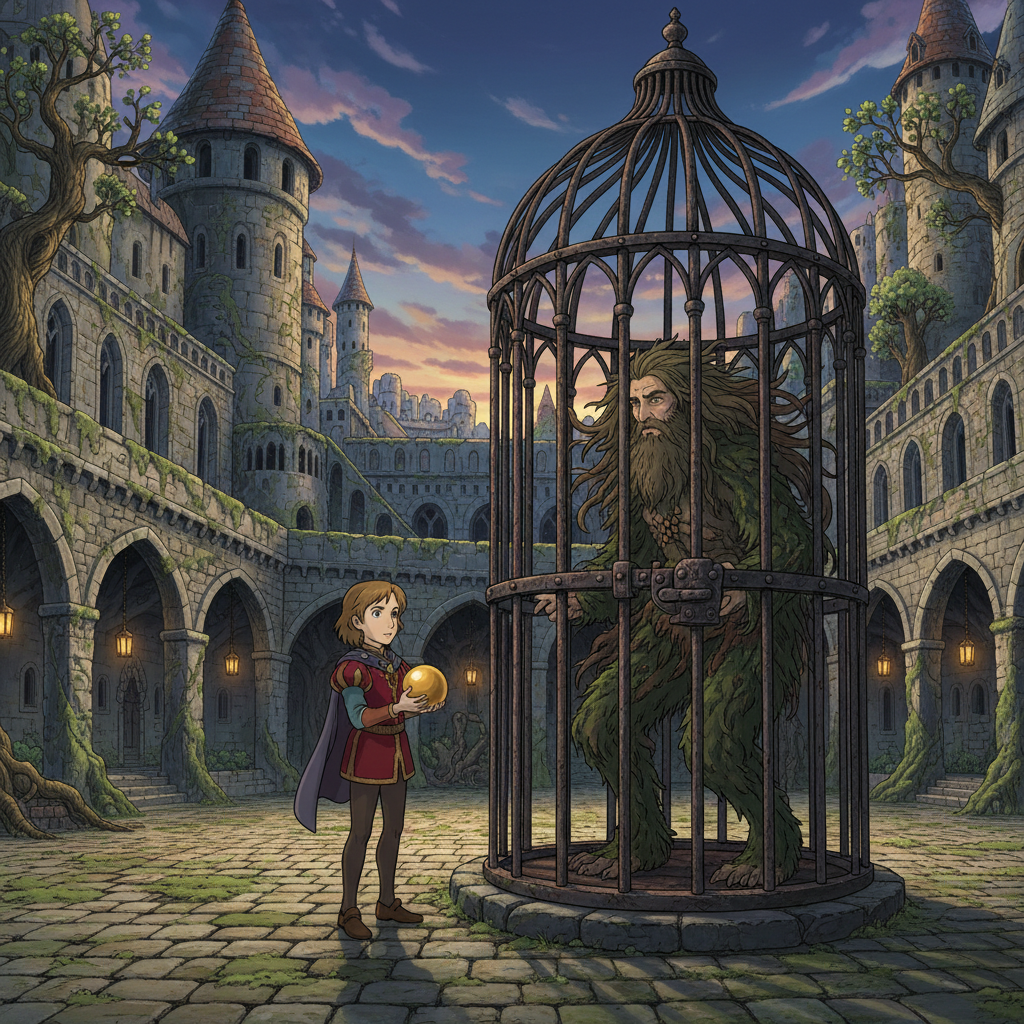
When the huntsman saw that, he went back and fetched three men to come with buckets and bale out the water. When they could see the bottom, there lay a Wild Man whose body was brown like rusty iron, and whose hair hung over his face down to his knees. They bound him with cords, and led him away to the castle.
There was great astonishment over the Wild Man. The King had him put in an iron cage in his courtyard, and forbade the door to be opened on pain of death, and the Queen herself was to take the key into her keeping. And from this time forth, every one could once more go into the forest with safety.
The King had a son, eight years old, who one day was playing in the courtyard, and while he was playing, his golden ball fell into the cage. The boy ran thither and said, “Give me my ball.”
“Not till you have opened the door for me,” answered the man.
107 “No,” said the boy, “I will not do that. The King has forbidden it,” and ran away.
The next day he again went and asked for his ball. The Wild Man said, “Open my door,” but the boy would not.
On the third day when the King had ridden out hunting, the boy went once more and said, “I cannot open the door even if I wished, for I have not the key.”
Then the Wild Man said, “It lies under your mother’s pillow. You can get it there.”
The boy, who wanted to have his ball back, cast all thought to the winds, and brought the key. The door opened with difficulty, and the boy pinched his fingers. When it was open, the Wild Man stepped out, gave him the golden ball, and hurried away.
But the boy was afraid. He called and cried after him, “Oh, Wild Man, do not go away, or I shall be beaten!”
The Wild Man turned back, took him up, set him on his shoulder, and went with hasty steps into the forest.
When the King came home, he saw the empty cage, and asked the Queen how that had happened. She knew nothing about it, and sought the key, but it was gone. She called the boy, but no one answered. The King sent out people to seek for him in the fields, but they did not find him. Then he could easily guess what had happened, and much grief reigned in the Royal Court.
When the Wild Man had reached once more the dark forest, he took the boy down from his shoulder, and said to him, “You will never see your father and mother again, but I will keep you with me for you have set me free, and I pity you. If you 108 do all I bid you, you shall fare well. Of treasure and gold have I enough, and more than any one in the world.”
He made a bed of moss for the boy on which he slept. And the next morning, the man took him to a well, and said, “Behold, the gold well is as bright and clear as crystal; you shall sit beside it, and take care that nothing falls into it, or it will be polluted. I will come every evening to see if you have obeyed my order.”
The boy placed himself by the margin of the well, and often saw a golden fish or a golden snake show itself therein, and he took care that nothing fell in. As he was sitting thus, his finger hurt him so violently that without thinking he put it in the water. He drew it quickly out again, but saw that it was quite gilded. And whatsoever pains he took to wash the gold off again, all was to no purpose.
In the evening, Iron John came back, looked at the boy, and said, “What has happened to the well?”
“Nothing, nothing,” he answered, and held his finger behind his back, that the man might not see it.
But he said, “You have dipped your finger into the water. This time it may pass, but take care you do not again let anything get in.”
At daybreak the boy was already sitting by the well and watching it. His finger hurt him again, and he passed it over his head, and then unhappily a hair fell down into the well. He took it quickly out, but it was quite gilded.
Iron John came, and already knew what had happened. “You have let a hair fall into the well,” said he. “I will allow you to watch by it once more, but if this happens the third 109 time, then the well will be polluted, and you can no longer remain with me.”
On the third day, the boy sat by the well, and did not stir his finger, however much it hurt him. But the time was long to him, and he looked at the reflection of his face on the surface of the water. And as he still bent down more and more trying to look straight into the eyes, his long hair fell down from his shoulders into the water. He raised himself up quickly, but the whole of the hair of his head was golden, and shone like the sun.
You may imagine how terrified the poor boy was! He took his pocket-handkerchief and tied it round his head, in order that the man might not see it.
When he came, he already knew everything, and said, “Take off the handkerchief.” Then the golden hair streamed forth, and let the boy excuse himself as he might, it was of no use. “You have not stood the trial, and can no longer stay here. Go forth into the world. There you will learn what poverty is. But as you have not a bad heart, and as I mean well by you, there is one thing I will grant you. If you fall into any difficulty, come to the forest and cry, ‘Iron John,’ and then I will come and help you. My power is great, greater than you think, and I have gold and silver in abundance.”
Then the King’s Son left the forest, and walked by beaten and unbeaten paths ever onward, until at length he reached a great city. There he looked for work, but could find none, and he had learnt nothing by which he could help himself.
At length, he went to the palace, and asked if they would 110 take him in. The people about Court did not know what use to make of him, but they liked him, and told him to stay. At last, the cook took him into his service, and said he might carry wood and water, and rake the cinders together.
Once when it happened that no one else was at hand, the cook ordered him to carry the food to the royal table, but as he did not like to let his golden hair be seen, he kept his little hat on. Such a thing as that had never come under the King’s notice, and he said, “When you serve at the royal table you must take off your hat.”
He answered, “Ah, Lord, I cannot.”
Then the King had the cook called before him. He scolded him, and asked how he could take such a boy as that into his service; and said that he was to turn him off at once. The cook, however, had pity on him, and exchanged him for the gardener’s boy.
And now, the boy had to plant and water the garden, hoe and dig, and bear the wind and bad weather.
One day in summer when he was working alone in the garden, the day was so warm he took his little hat off that the air might cool him. As the sun shone on his hair it glittered and flashed so that the rays fell into the bedroom of the King’s Daughter. Up she sprang to see what it could be. Then she saw the boy, and cried to him, “Boy, bring me a wreath of flowers.”
He put his hat on with all haste, and gathered wild field-flowers and bound them together. When he was ascending the stairs with them, the gardener met him, and said, “How can you take the King’s Daughter a garland of such common flowers? 111 Go quickly, and get another, and seek out the prettiest and rarest.”
“Oh, no,” replied the boy, “the wild ones have more scent, and will please her better.”
When he went into the room, the King’s Daughter said, “Take your cap off, it is not seemly to keep it on in my presence.”
He again said, “I cannot.”
She, however, caught at his hat and pulled it off, and then his golden hair rolled down on his shoulders. And it was splendid to behold.
He wanted to run out, but she held him by the arm, and gave him a handful of ducats. With these he departed, but he cared nothing for the gold pieces. He took them to the gardener, and said, “I give them to your children, they may play with them.”
The following day, the King’s Daughter again called to him that he was to bring her a wreath of field-flowers. When he went in with it, she snatched at his hat, and wanted to take it away from him, but he held it fast with both hands. She again gave him a handful of ducats. But he would not keep them, and presented them to the gardener as playthings for his children.
On the third day, things went just the same. She could not get his hat away from him, and he would not have her money.
Not long afterward, the country was overrun by war. The King gathered together his people, and did not know whether or not he could overcome the enemy, who was superior in strength and had a mighty army.
112 Then said the gardener’s boy, “I am grown up, and will go to the wars also, only give me a horse.”
The others laughed, and said, “Seek one for yourself when we are gone. We will leave one behind us in the stable for you.”
When they had gone forth, he went into the stable, and got the horse. It was lame of one foot, and limped hobblety jig, hobblety jig . Nevertheless he mounted it, and rode away to the dark forest. When he came to the outskirts, he called “Iron John” three times so loudly that it echoed through the trees.
Thereupon the Wild Man appeared immediately, and said, “What do you desire?”
“I want a strong steed, for I am going to the wars.”
“That you shall have, and still more than you ask.” Then the Wild Man went back into the forest, and it was not long before a stable-boy came out of it, who led a horse that snorted, and could hardly be restrained. Behind them followed a great troop of soldiers entirely equipped in iron, and their swords flashed in the sun. The youth made over his three-legged horse to the stable-boy, mounted the other, and rode at the head of the soldiers.
When he drew near the battle-field, a great part of the King’s men had already fallen, and little was wanting to make the rest give way. Then the youth galloped thither with his iron soldiers, broke like a hurricane over the enemy, and beat down all who opposed him. They began to fly, but the youth pursued, and never stopped, until there was not a single man left.
113 Instead, however, of returning to the King, he conducted his troop by side-roads to the forest, and called Iron John.
“What do you desire?” asked the Wild Man.
“Take back your horse and troops, and give me my three-legged horse again.” All that he asked was done, and soon he was riding on his three-legged horse.
When the King returned to his palace, his daughter went to meet him, and wished him joy of his victory. “I am not the one who carried away the victory,” said he, “but a stranger Knight who came to my assistance with his soldiers.” The daughter wanted to hear who the strange Knight was, but the King did not know, and said, “He followed the enemy, and I did not see him again.”
She inquired of the gardener where his boy was, but he smiled, and said, “He has just come home on his three-legged horse, and the others have been mocking him, and crying, ‘Here comes our hobblety jig back again!’ They asked, too, ‘Under what hedge have you been lying sleeping all the time?’ He, however, answered, ‘I did the best of all, and it would have gone badly without me.’ And then he was ridiculed still more.”
The King said to his daughter, “I will proclaim a great feast that shall last for three days, and you shall throw a Golden Apple. Perhaps the unknown will come to it.”
When the feast was announced, the youth went out to the forest, and called Iron John.
“What do you desire?” asked he.
“That I may catch the King’s Daughter’s Golden Apple.”
“It is as safe as if you had it already,” said Iron John. 114 “You shall likewise have a suit of red armor for the occasion, and ride on a spirited chestnut horse.”
When the day came, the youth galloped to the spot, took his place amongst the Knights, and was recognized by no one. The King’s Daughter came forward, and threw a Golden Apple to the Knights. None of them caught it but he; only as soon as he had it, he galloped away.
On the second day, Iron John equipped him as a white Knight, and gave him a white horse. Again he was the only one who caught the apple, and he did not linger an instant, but galloped off with it.
The King grew angry, and said, “That is not allowed. He must appear before me and tell his name.” He gave the order that if the Knight who caught the apple should go away again, they should pursue him, and, if he would not come back willingly, they should cut him down and stab him.
On the third day, he received from Iron John a suit of black armor and a black horse. Again he caught the apple. But when he was riding off with it, the King’s attendants pursued him, and one of them got so near that he wounded the youth’s leg with the point of his sword. The youth nevertheless escaped from them, but his horse leapt so violently that the helmet fell from his head, and they could see that he had golden hair. They rode back and announced this to the King.
The following day, the King’s Daughter asked the gardener about his boy. “He is at work in the garden. The queer creature has been at the festival too, and only came home yesterday evening. He has likewise shown my children three Golden Apples which he has won.”
115 The King had him summoned into his presence. He came and again had his hat on his head. But the King’s Daughter went up to him and took it off. Then his golden hair fell down over his shoulders, and he was so handsome that all were amazed.
“Are you the Knight who came every day to the festival, always in different colors, and who caught the three Golden Apples?” asked the King.
“Yes,” answered he, “and here are the apples,” and he took them out of his pocket, and returned them to the King. “If you desire further proof, you may see the wound which your people gave me when they followed me. But I am likewise the Knight who helped you win your victory over your enemies.”
“If you can perform such deeds as that, you are no gardener’s boy. Tell me, who is your father?”
“My father is a mighty King, and gold have I in plenty as much as I require.”
“I well see,” said the King, “that I owe thanks to you. Can I do anything to please you?”
“Yes,” answered he, “that indeed you can. Give me your daughter to wife.”
The maiden laughed, and said, “He does not stand much on ceremony, but I have already seen by his golden hair that he is no gardener’s boy,” and then she went and kissed him.
His father and mother came to the wedding, and were in great delight, for they had given up all hope of ever seeing their dear son again. And as they were sitting at the marriage-feast, the music suddenly stopped, the doors opened, and a stately King came in with a great retinue.
116 He went up to the youth, embraced him and said, “I am Iron John, and was by enchantment a Wild Man, but you have set me free. All the treasures which I possess, shall be yours.”
<center>* * *</center>
Moral of the Story
True worth and noble character will eventually be recognized, and perseverance through trials leads to reward.
Characters

Iron John ◆ supporting
Body brown like rusty iron, hair hanging over his face down to his knees
Attire: Naked, later a stately king's attire
Powerful, generous, enchanted, grateful

King ◆ supporting
No specific details given
Attire: Royal attire appropriate to the kingdom
Anxious, grateful, authoritative

Queen ○ minor
No specific details given
Attire: Royal attire appropriate to the kingdom
Trusting, responsible (initially)

King's Son / Gardener's Boy / Knight ★ protagonist
Handsome, golden hair
Attire: Initially simple clothes, then red, white, and black armor, finally revealed to be princely attire
Curious, obedient (initially), brave, resourceful

King's Daughter ◆ supporting
No specific details given
Attire: Princessly attire appropriate to the kingdom
Observant, discerning, decisive
Locations

The King's Forest
A vast, wild forest near the palace, initially teeming with all kinds of wild animals, but later characterized by deep stillness and solitude.
Mood: Initially wild and natural, later becomes eerie, dangerous, and silent.
Huntsmen disappear, Iron John is found, the boy and Iron John escape.

Iron John's Cage in the Courtyard
An iron cage in the King's courtyard, where Iron John is imprisoned.
Mood: Confining, oppressive, a spectacle.
The boy loses his golden ball, bargains with Iron John, and ultimately releases him.

The Golden Well
A well in the dark forest with water as bright and clear as crystal.
Mood: Magical, pristine, a test of purity.
The boy is tasked with keeping the well pure, but fails three times.

The Battlefield
A field where the King's army is losing a battle.
Mood: Chaotic, desperate, violent.
The youth, aided by Iron John's soldiers, turns the tide of the battle and secures victory for the King.

The King's Palace Feast Hall
A grand hall where a three-day feast is held, and golden apples are thrown as prizes.
Mood: Festive, celebratory, filled with knights and royalty.
The youth, disguised as a knight, wins the golden apples, is wounded, and eventually reveals his true identity.
Story DNA
Moral
True worth and noble character will eventually be recognized, and perseverance through trials leads to reward.
Plot Summary
A King's forest becomes dangerous until a Wild Man is captured and caged. The King's son releases the Wild Man, who takes him into the forest and sets him a task guarding a golden well. The boy repeatedly fails, resulting in golden hair, and is banished but promised aid. He finds work as a lowly gardener's boy in another kingdom, hiding his identity. With the Wild Man's magical help, he secretly wins a war and catches three golden apples from the Princess, revealing his golden hair. The King summons him, he reveals his true identity as a prince, and marries the Princess, with the Wild Man revealing himself to be an enchanted King.
Themes
Emotional Arc
suffering to triumph
Writing Style
Narrative Elements
Cultural Context
Reflects a pre-industrial, feudal society where kings ruled and forests were seen as both resource and dangerous unknown. The 'Wild Man' figure has roots in European folklore, often representing untamed nature or a primal masculine force.
Plot Beats (15)
- Huntsmen disappear in the King's forest; a Wild Man is discovered in a pool, captured, and caged.
- The King's young son loses his golden ball into the Wild Man's cage.
- The Wild Man persuades the boy to steal the key from his mother and release him, then takes the boy into the forest.
- Iron John instructs the boy to guard a golden well, but the boy accidentally contaminates it three times, first with his finger, then a hair, then his entire golden hair.
- Iron John banishes the boy, but promises aid if called upon, and the boy leaves the forest with hidden golden hair.
- The boy finds work as a lowly gardener's assistant in a distant kingdom, always keeping his golden hair covered.
- The boy, still disguised, serves the King's table and later the Princess, refusing to remove his cap, but the Princess eventually pulls it off, revealing his golden hair, which he quickly re-covers.
- War breaks out, and the boy, mocked by others, calls Iron John, who provides a powerful steed and an army of iron soldiers.
- The boy, as a mysterious knight, leads Iron John's army to victory for the King, then returns the magical aid and resumes his disguise.
- The King announces a three-day feast where the Princess will throw a golden apple.
- On three consecutive days, the boy, aided by Iron John, appears as a knight in different colored armor, catches the golden apple, and gallops away, revealing his golden hair on the third day when wounded.
- The King summons the gardener's boy, who reveals his golden hair, presents the apples, and confesses to being the mysterious knight and war hero.
- The Prince reveals his royal lineage, asks for the Princess's hand, and she accepts.
- At the wedding, Iron John appears, reveals he was an enchanted King, and bestows his treasures upon the newlywed Prince.
- The Prince's long-lost parents arrive, overjoyed to be reunited with their son.