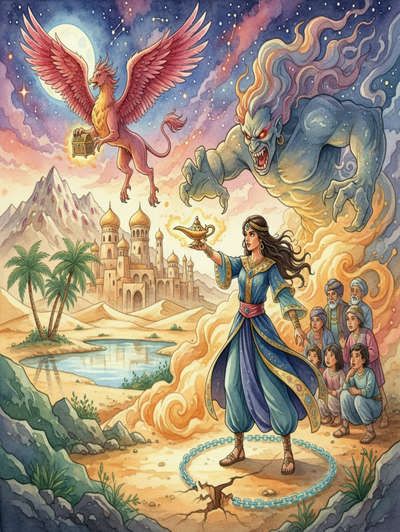
Samba the coward
by Andrew Lang

Samba the Brave
Once, there was a prince named Samba. He was afraid of everything. Loud sounds scared him. Dark nights made him hide. He feared animals and storms. He never played outside. His father, the king, felt sad. The people in the kingdom worried. They wanted a brave prince.
One day, bad men came to their land. They stole sheep from the fields. The bad men were loud and mean. They took many sheep. Samba heard the noise. He ran to his small hut. His friends saw him hide. They were upset with him. They called him "Samba the Coward."
Samba felt very sad about this. He decided to leave his home. He packed some food. He said goodbye to no one. He rode a horse to a new city. The journey was long and scary. The road was bumpy. He saw new places. He felt alone but hopeful. But Samba kept going, hoping for happiness.
In the new city, a princess saw Samba. She liked him very much. The princess was kind and pretty. She smiled at Samba. She wanted to marry him. Her father, the king, said yes. They had a happy wedding. The wedding was big and fun. The whole city came to celebrate. People ate and danced together. Everyone was happy.
The princess loved Samba a lot. She hoped he could be brave. She dreamed of a brave husband. She wanted him to be a hero. She told Samba stories of heroes. She believed in him. Samba listened and hoped. She often told him kind words. She encouraged him every day.
One day, bad men attacked the city. The city was under attack. People ran and hid. Samba was very scared. He hid in the cellar. The princess was brave. She found a safe cellar. She acted fast. She wore Samba's armor. She put on heavy armor. She gathered the soldiers. She led the soldiers to fight. They fought hard. They won the battle. The enemies were defeated. The people cheered for her.
The princess came back home. She returned victorious. She put armor on Samba. She dressed Samba in armor. She told all people he was the hero. She announced his bravery. The crowd believed her. The people cheered for Samba. They lifted Samba up. They sang songs for him. They were very happy. They thought he was strong.
The bad men came again. The princess fought them bravely. She got a small scratch on her arm. She went to Samba. "I am hurt," she said. "You must be brave now." Samba was scared. The princess helped him. She pretended to be in pain. She asked Samba to be strong. Samba trembled but agreed. She told all people he was hurt. The princess told everyone he was hurt in battle.
The bad men came back again. The princess had a clever plan. "My scratch hurts," she said. "You must go to the battle place." The princess whispered a plan to Samba. She said he must go to the battle. Samba rode his horse. The princess helped the horse. She guided his horse gently. The horse ran to the fight. The horse moved towards the fight.
Samba was in the battle. He had to fight. He faced the enemies. He remembered his wife's words. He found his courage inside. He fought with all his courage. He fought bravely. His courage grew. He led the charge. He won the battle. The bad men were scared. They ran away. They fled away.
Samba came back a true hero. He felt proud of himself. He realized he could be brave. He thanked his wife silently. He went to the king. "My wife helped me," he said. "She made me brave." Samba told the king the truth. He praised his wife's help. The king was happy. The king listened carefully. He was proud of both. He thanked them both. All people cheered. They had a big party. The kingdom celebrated for days. There was music and food.
Samba smiled at his wife. "Anyone can be brave," he said. "With help from friends." Samba and his wife were happy. They knew courage comes with support. They lived with joy. The kingdom was safe and happy.
Original Story
_SAMBA THE COWARD_ In the great country far away south, through which flows the river Nile, there lived a king who had an only child called Samba. Now, from the time that Samba could walk he showed signs of being afraid of everything, and as he grew bigger he became more and more frightened. At first his father's friends made light of it, and said to each other: 'It is strange to see a boy of our race running into a hut at the trumpeting of an elephant, and trembling with fear if a lion cub half his size comes near him; but, after all, he is only a baby, and when he is older he will be as brave as the rest.' 'Yes, he is only a baby,' answered the king who overheard them, 'it will be all right by-and-by.' But, somehow, he sighed as he said it, and the men looked at him and made no reply. The years passed away, and Samba had become a tall and strong youth. He was good-natured and pleasant, and was liked by all, and if during his father's hunting parties he was seldom to be seen in any place of danger, he was too great a favourite for much to be said. 'When the king holds the feast and declares him to be his heir, he will cease to be a child,' murmured the rest of the people, as they had done before; and on the day of the ceremony their hearts beat gladly, and they cried to each other: 'It is Samba, Samba, whose chin is above the heads of other men, who will defend us against the tribes of the robbers!' * * * * * Not many weeks after, the dwellers in the village awoke to find that during the night their herds had been driven away, and their herdsmen carried off into slavery by their enemies. Now was the time for Samba to show the brave spirit that had come to him with his manhood, and to ride forth at the head of the warriors of his race. But Samba could nowhere be found, and a party of the avengers went on their way without him. It was many days later before he came back, with his head held high, and a tale of a lion which he had tracked to its lair and killed, at the risk of his own life. A little while earlier and his people would have welcomed his story, and believed it all, but now it was too late. 'Samba the Coward,' cried a voice from the crowd; and the name stuck to him, even the very children shouted it at him, and his father did not spare him. At length he could bear it no longer, and made up his mind to leave his own land for another where peace had reigned since the memory of man. So, early next morning, he slipped out to the king's stables, and choosing the quietest horse he could find, he rode away northwards. Never as long as he lived did Samba forget the terrors of that journey. He could hardly sleep at night for dread of the wild beasts that might be lurking behind every rock or bush, while, by day, the distant roar of a lion would cause him to start so violently, that he almost fell from his horse. A dozen times he was on the point of turning back, and it was not the terror of the mocking words and scornful laughs that kept him from doing so, but the terror lest he should be forced to take part in their wars. Therefore he held on, and deeply thankful he felt when the walls of a city, larger than he had ever dreamed of, rose before him. Drawing himself up to his full height, he rode proudly through the gate and past the palace, where, as was her custom, the princess was sitting on the terrace roof, watching the bustle in the street below. 'That is a gallant figure,' thought she, as Samba, mounted on his big black horse, steered his way skilfully among the crowds; and, beckoning to a slave, she ordered him to go and meet the stranger, and ask him who he was and whence he came. 'Oh, princess, he is the son of a king, and heir to a country which lies near the Great River,' answered the slave, when he had returned from questioning Samba. And the princess on hearing this news summoned her father, and told him that if she was not allowed to wed the stranger she would die unmarried. Like many other fathers, the king could refuse his daughter nothing, and besides, she had rejected so many suitors already that he was quite alarmed lest no man should be good enough for her. Therefore, after a talk with Samba, who charmed him by his good humour and pleasant ways, he gave his consent, and three days later the wedding feast was celebrated with the utmost splendour. The princess was very proud of her tall handsome husband, and for some time she was quite content that he should pass the days with her under the palm trees, telling her the stories that she loved, or amusing her with tales of the manners and customs of his country, which were so different to those of her own. But, by-and-by, this was not enough; she wanted other people to be proud of him too, and one day she said: 'I really almost wish that those Moorish thieves from the north would come on one of their robbing expeditions. I should love so to see you ride out at the head of our men, to chase them home again. Ah, how happy I should be when the city rang with your noble deeds!' [Illustration: SAMBA FOUND SKULKING BY HIS WIFE] She looked lovingly at him as she spoke; but, to her surprise, his face grew dark, and he answered hastily: 'Never speak to me again of the Moors or of war. It was to escape from them that I fled from my own land, and at the first word of invasion I should leave you for ever.' 'How funny you are,' cried she, breaking into a laugh. 'The idea of anyone as big as you being afraid of a Moor! But still, you mustn't say those things to anyone except me, or they might think you were in earnest.' * * * * * Not very long after this, when the people of the city were holding a great feast outside the walls of the town, a body of Moors, who had been in hiding for days, drove off all the sheep and goats which were peacefully feeding on the slopes of a hill. Directly the loss was discovered, which was not for some hours, the king gave orders that the war drum should be beaten, and the warriors assembled in the great square before the palace, trembling with fury at the insult which had been put upon them. Loud were the cries for instant vengeance, and for Samba, son-in-law of the king, to lead them to battle. But shout as they might, Samba never came. And where was he? No further than in a cool, dark cellar of the palace, crouching among huge earthenware pots of grain. With a rush of pain at her heart, there his wife found him, and she tried with all her strength to kindle in him a sense of shame, but in vain. Even the thought of the future danger he might run from the contempt of his subjects was as nothing when compared with the risks of the present. 'Take off your tunic of mail,' said the princess at last; and her voice was so stern and cold that none would have known it. 'Give it to me, and hand me besides your helmet, your sword and your spear.' And with many fearful glances to right and to left, Samba stripped off the armour inlaid with gold, the property of the king's son-in-law. Silently his wife took, one by one, the pieces from him, and fastened them on her with firm hands, never even glancing at the tall form of her husband who had slunk back to his corner. When she had fastened the last buckle, and lowered her vizor, she went out, and mounting Samba's horse, gave the signal to the warriors to follow. Now, although the princess was much shorter than her husband, she was a tall woman, and the horse which she rode was likewise higher than the rest, so that when the men caught sight of the gold-inlaid suit of chain armour, they did not doubt that Samba was taking his rightful place, and cheered him loudly. The princess bowed in answer to their greeting, but kept her vizor down; and touching her horse with the spur, she galloped at the head of her troops to charge the enemy. The Moors, who had not expected to be so quickly pursued, had scarcely time to form themselves into battle array, and were speedily put to flight. Then the little troop of horsemen returned to the city, where all sung the praises of Samba their leader. The instant they reached the palace the princess flung her reins to a groom, and disappeared up a side staircase, by which she could, unseen, enter her own rooms. Here she found Samba lying idly on a heap of mats; but he raised his head uneasily as the door opened and looked at his wife, not feeling sure how she might act towards him. However, he need not have been afraid of harsh words: she merely unbuttoned her armour as fast as possible, and bade him put it on with all speed. Samba obeyed, not daring to ask any questions; and when he had finished the princess told him to follow her, and led him on to the flat roof of the house, below which a crowd had gathered, cheering lustily. 'Samba, the king's son-in-law! Samba, the bravest of the brave! Where is he? Let him show himself!' And when Samba did show himself the shouts and applause became louder than ever. 'See how modest he is! He leaves the glory to others!' cried they. And Samba only smiled and waved his hand, and said nothing. Out of all the mass of people assembled there to do honour to Samba, one alone there was who did not shout and praise with the rest. This was the princess's youngest brother, whose sharp eyes had noted certain things during the fight which recalled his sister much more than they did her husband. Under promise of secrecy, he told his suspicions to the other princes, but only got laughed at, and was bidden to carry his dreams elsewhere. 'Well, well,' answered the boy, 'we shall see who is right; but the next time we give battle to the Moors I will take care to place a private mark on our commander.' In spite of their defeat, not many days after the Moors sent a fresh body of troops to steal some cattle, and again Samba's wife dressed herself in her husband's armour, and rode out at the head of the avenging column. This time the combat was fiercer than before, and in the thick of it her youngest brother drew near, and gave his sister a slight wound on the leg. At the moment she paid no heed to the pain, which, indeed, she scarcely felt; but when the enemy had been put to flight and the little band returned to the palace, faintness suddenly overtook her, and she could hardly stagger up the staircase to her own apartments. 'I am wounded,' she cried, sinking down on the mats where he had been lying, 'but do not be anxious; it is really nothing. You have only got to wound yourself slightly in the same spot and no one will guess that it was I and not you who were fighting.' 'What!' cried Samba, his eyes nearly starting from his head in surprise and terror. 'Can you possibly imagine that I should agree to anything so useless and painful? Why, I might as well have gone to fight myself!' 'Ah, I ought to have known better, indeed,' answered the princess, in a voice that seemed to come from a long way off; but, quick as thought, the moment Samba turned his back she pierced one of his bare legs with a spear. He gave a loud scream and staggered backwards, from astonishment, much more than from pain. But before he could speak his wife had left the room and had gone to seek the medicine man of the palace. 'My husband has been wounded,' said she, when she had found him, 'come and tend him with speed, for he is faint from loss of blood.' And she took care that more than one person heard her words, so that all that day the people pressed up to the gate of the palace, asking for news of their brave champion. 'You see,' observed the king's eldest sons, who had visited the room where Samba lay groaning, 'you see, O wise young brother, that we were right and you were wrong about Samba, and that he really _did_ go into the battle.' But the boy answered nothing, and only shook his head doubtfully. It was only two days later that the Moors appeared for the third time, and though the herds had been tethered in a new and safer place, they were promptly carried off as before. 'For,' said the Moors to each other, 'the tribe will never think of our coming back so soon when they have beaten us so badly.' When the drum sounded to assemble all the fighting men, the princess rose and sought her husband. 'Samba,' cried she, 'my wound is worse than I thought. I can scarcely walk, and could not mount my horse without help. For to-day, then, I cannot do your work, so you must go instead of me.' 'What nonsense,' exclaimed Samba, 'I never heard of such a thing. Why, I might be wounded, or even killed! You have three brothers. The king can choose one of them.' 'They are all too young,' replied his wife; 'the men would not obey them. But if, indeed, you will not go, at least you can help me harness my horse.' And to this Samba, who was always ready to do anything he was asked when there was no danger about it, agreed readily. So the horse was quickly harnessed, and when it was done the princess said: 'Now ride the horse to the place of meeting outside the gates, and I will join you by a shorter way, and will change places with you.' Samba, who loved riding in times of peace, mounted as she had told him, and when he was safe in the saddle, his wife dealt the horse a sharp cut with her whip, and he dashed off through the town and through the ranks of the warriors who were waiting for him. Instantly the whole place was in motion. Samba tried to check his steed, but he might as well have sought to stop the wind, and it seemed no more than a few minutes before they were grappling hand to hand with the Moors. Then a miracle happened. Samba the coward, the skulker, the terrified, no sooner found himself pressed hard, unable to escape, than something sprang into life within him, and he fought with all his might. And when a man of his size and strength begins to fight he generally fights well. That day the victory was really owing to Samba, and the shouts of the people were louder than ever. When he returned, bearing with him the sword of the Moorish chief, the old king pressed him in his arms and said: 'Oh, my son, how can I ever show you how grateful I am for this splendid service?' But Samba, who was good and loyal when fear did not possess him, answered straightly: 'My father, it is to your daughter and not to me to whom thanks are due, for it is she who has turned the coward that I was into a brave man.' (_Contes Soudainais._ Par C. Monteil.)
Moral of the Story
True courage can be awakened even in the most fearful, often through unexpected circumstances or the influence of others.
Characters

Samba ★ protagonist
Tall and strong youth
Attire: Initially, fine robes befitting a prince; later, ill-fitting armor
Cowardly, good-natured, easily influenced, ultimately brave

The Princess ◆ supporting
Not explicitly described, but implied to be beautiful and regal
Attire: Fine robes and jewelry befitting a princess; later, Samba's armor
Determined, resourceful, brave, manipulative

The King (Samba's father) ◆ supporting
Not explicitly described, but implied to be strong and regal
Attire: Royal robes and jewelry
Concerned, hopeful, ultimately grateful

The King (Princess's father) ◆ supporting
Not explicitly described, but implied to be wise and regal
Attire: Royal robes and jewelry
Permissive, easily charmed, values his daughter's happiness

The Princess's youngest brother ○ minor
Not explicitly described
Attire: Princely attire
Observant, suspicious, persistent
Locations

Samba's Village
A village in a great country far away south, through which flows the river Nile. Huts are present. Herds of animals are kept nearby.
Mood: Initially peaceful, later filled with fear and shame
Samba is publicly shamed as a coward after failing to defend the village from raiders; he flees in disgrace.

The Road North
A dangerous path filled with rocks and bushes, leading to a distant city.
Mood: Terrifying and lonely
Samba journeys away from his homeland, constantly in fear of wild beasts.

The Princess's City
A large city with walls and a palace. The princess watches the bustling street from the terrace roof.
Mood: Bustling and prosperous
Samba arrives and is noticed by the princess, leading to their marriage.

The Flat Roof
A flat roof of a house, overlooking a crowd of cheering people.
Mood: Triumphant and deceptive
Samba is presented to the crowd as a hero, while his wife has actually done the fighting.

Battlefield Outside the City
Open area outside the city walls where the city's warriors clash with Moorish raiders.
Mood: Chaotic and dangerous
Samba accidentally finds himself in battle and discovers his courage, leading to victory.
Story DNA
Moral
True courage can be awakened even in the most fearful, often through unexpected circumstances or the influence of others.
Plot Summary
Samba, a prince known for his extreme cowardice, flees his homeland after being publicly shamed. He marries a princess in a new kingdom, but his fear resurfaces during a raid. His wife secretly takes his place in battle, leading the army to victory while maintaining his false heroic image. After she is wounded, she devises a cunning plan to force Samba into battle, where he unexpectedly discovers his own courage and leads his people to a decisive victory. Samba returns a true hero, confessing his past and crediting his wife for his transformation.
Themes
Emotional Arc
shame to pride
Writing Style
Narrative Elements
Cultural Context
The story is attributed to 'Contes Soudainais' by C. Monteil, suggesting an origin or influence from Sudanese oral traditions, likely collected and retold in French. The 'Moors' reference places it in a context where North African or Arab groups were known for raiding.
Plot Beats (14)
- Samba is introduced as a prince who is cowardly from childhood, disappointing his father and people.
- As a young man, Samba is publicly shamed for his cowardice when he hides during a raid by enemies, earning him the name 'Samba the Coward'.
- Unable to bear the shame, Samba flees his homeland and travels north, terrified by the journey.
- He arrives in a new city, where a princess sees him and falls in love, insisting on marrying him.
- Samba marries the princess, charming her father with his pleasant demeanor, but his wife soon desires him to be a hero.
- Moorish thieves raid the city; Samba hides in a cellar, and his wife, disgusted, takes his armor and leads the army to victory in his place.
- The princess returns, has Samba put on the armor, and presents him as the hero to the cheering crowd, though her younger brother is suspicious.
- The Moors raid again; the princess again fights in Samba's place, is wounded, and returns to trick Samba into wounding himself to maintain the deception.
- Samba refuses to wound himself, revealing his deep-seated fear, but the princess wounds him herself and then tells the palace that he was wounded in battle.
- The Moors raid a third time; the princess, feigning inability to fight due to her 'wound', tricks Samba into riding out to the assembly point.
- The princess whips Samba's horse, sending him uncontrollably into battle against the Moors.
- Forced to fight, Samba discovers his inner courage and leads his army to a great victory.
- Samba returns a true hero, confesses his past cowardice and his wife's pivotal role in his transformation to his father-in-law.
- The king expresses gratitude, and Samba is celebrated as a brave man, acknowledging his wife's contribution.