The little soldier
by Andrew Lang

John's Kind Adventure
Once, a brave young man named John lived. He walked far and wide. He had no home. John loved to help others. He traveled through forests and fields. He had only a small bag. One night, it was dark. He needed light for his lantern. He looked for his matchbox. It was gone! He felt sad. The night was cold and quiet. He wanted to light his lantern to see. But his matchbox was missing. He searched everywhere. He felt very alone.
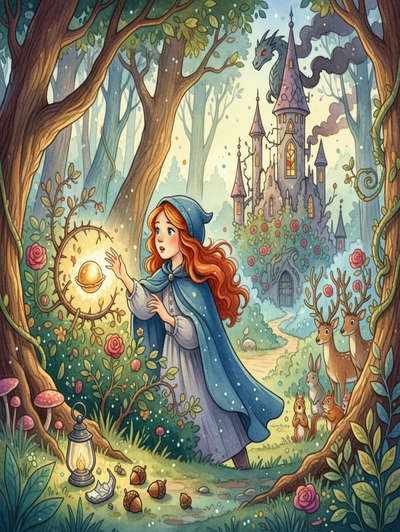
Then he saw a light. It came from an old castle. The castle was tall and old. It had big windows. The light was warm and inviting. John felt curious. The door was open. John went inside carefully. He saw a big fire. He knocked on the door. No one answered. He went in. He went to the fire. He wanted a hot coal.
Then, a shape moved in the fire! It was a magic princess. Her name was Ludo. She was half snake. She was not scary. She looked friendly. A beautiful woman with a snake tail appeared. She smiled gently. "Help me, please," she said. "I am under a spell. You can break it." "Please help me," she said softly. "I am trapped by a spell."
"What must I do?" asked John.
"Open that door," said Ludo. "Find my tunic. Bring it to me."
John was brave. He opened the door. He saw a room. The room was full of magic. There were many hands! They clapped softly. They were not mean. The hands clapped happily. They were friendly and helpful. They pointed to a closet. John found the tunic. It was orange and pretty. He brought it to Ludo.
She put it on. Now she was a woman to her waist.
"Thank you," she said. "Now please find my skirt. It is upstairs."
John went upstairs. The stairs were wide and clean. He saw friendly guards. They waved their arms. They showed him the way. The guards wore shiny armor. They smiled and waved. One guard showed John a door. He found the blue skirt. It had pretty patterns. He brought it to Ludo.
She put it on. Now she was a woman to her knees.
"One more thing," she said. "Please find my shoes and stockings. They are on the next floor."
John went up again. He saw small, shy creatures. They were goblins. They looked scared. The goblins were small and had big eyes. They hid at first. John smiled. He was kind to them. John spoke kindly to them. "Don't be scared," he said. The goblins helped him. They gave him the shoes and stockings. The goblins came out. They gave him shiny shoes and warm stockings. John thanked them.
He brought them to Ludo. She put them on. She was a full woman now! She was pretty.
"Thank you, John," she said. "You must go now. Sleep at the inn. I will come for you in the morning. Here is a purse with coins. And have a drink to rest."
She gave him a glass of juice. John drank it. Ludo gave him sweet juice. It tasted like berries. He felt very sleepy. He fell asleep. John felt very relaxed. He sat down on a soft chair. Soon, he was fast asleep. Ludo looked at him kindly. She had to leave quickly. She forgot to wake him up.
In the morning, John woke up late. The sun was high. He ran outside. The sun was bright in the sky. John woke up feeling confused. He saw a carriage go by. It was Ludo! She did not see him. He ran outside but saw no one. A carriage was leaving. He saw Ludo inside. She was looking ahead. John called out, but she didn't hear. John was sad. He held some yellow flowers she left. He found yellow flowers on the ground. They smelled sweet. He decided to look for her. John decided to find Ludo. He wanted to see her again.
John walked far. He found a magic tree. John walked through a green forest. He found a special tree. It had two kinds of plums. Green plums made funny horns grow. Blue plums took the horns away. It had two colors of plums. Green plums sparkled in the sun. Blue plums looked juicy. John learned about their magic. Green plums could grow funny horns. Blue plums could make them go away. John had an idea. He picked some green plums. He put them in his bag.
He went to Ludo's kingdom. He dressed like a fruit seller. John changed his clothes. He wore a hat and a coat. He looked like a fruit seller. He sold the green plums. He went to the market. He set up a small stand. People came to buy fruits. Ludo bought some. She ate them. Ludo walked by. She saw the green plums. They looked delicious. She bought some. She ate one right away.
Oh no! Two little horns grew on her head! They were silly horns. Two little horns appeared on Ludo's head. They were soft and silly. Ludo was upset. Ludo looked in a mirror. She was surprised. The King, her father, was worried. He asked for help. The King saw her. He was very concerned. He called for help. "Please, who can remove the horns?" he said. "Please, who can fix this?" he asked. Many people tried but failed.
John was kind. He wanted to help. He dressed like a doctor. John wore a doctor's coat. He carried a small bag. He went to the castle. "I can help," he said. The King let him in.
He saw Ludo. He gave her juice from a blue plum. The horns got smaller. John saw Ludo. She looked sad. He gave her blue plum juice. She drank it. The horns became smaller. Everyone was happy.
"Be sorry to remove them," said John. "Did you take something that was not yours?" John spoke softly to Ludo. "To make the horns go away, you must be sorry for any mistakes," he said.
Ludo knew. "Yes," she said. "I took your purse. I am sorry." She gave back the purse. Ludo thought carefully. "I remember," she said. "I took your purse. I am very sorry." She returned the purse.
John gave her more juice. The horns got even smaller.
"Is there more?" he asked. John smiled. "Is there anything else?" he asked.
"I also took your cloak," said Ludo. "I am sorry," she said, returning the cloak. "Yes," said Ludo. "I also took your cloak. I apologize." She gave back the cloak. John was pleased.
John smiled. He took off his doctor clothes. "Hello, Ludo," he said. John took off his doctor clothes. He showed his real face.
Ludo was surprised. "John!" she said. "Thank you for helping me." Ludo was surprised and happy. "Thank you, John," she said.
They were not angry. John got his things back. The horns were all gone. John said goodbye. He was happy he helped. They shook hands. John left the castle. He felt good about helping. The horns were completely gone. Ludo was grateful.
John traveled on. He found the sea. John walked to the sea. The water was blue and calm. He saw his friend, Seagull. She was mending a net. She smiled. He saw his friend, Seagull. She was working on a fishing net. She looked up and saw John. Her face lit up.
"John! You are back!" she said. "John! You are back!" she said happily.
John told her his story. He gave her the purse and cloak. "I do not need these," he said. "Joy is not in things." John shared his adventures with Seagull. He gave her the purse and cloak. "I don't need these things," he said. "True joy comes from kindness and work."
"Joy is in work and friends," said Seagull. Seagull agreed.
"Will you be my best friend?" asked John. "Will you be your best friend?" asked John.
"Yes!" said Seagull. They put the purse and cloak in a pot. They threw it into the sea. They smiled. "Yes!" said Seagull. They put the purse and cloak in a pot. They threw it into the sea. They smiled at each other.
John learned kindness and hard work bring joy. John and Seagull were ready for adventures. They were very happy. John learned that being kind and working hard brings happiness. John and Seagull were ready for new adventures. They were very happy together.
Original Story
_THE LITTLE SOLDIER_ I Once upon a time there was a little soldier who had just come back from the war. He was a brave little fellow, but he had lost neither arms nor legs in battle. Still, the fighting was ended and the army disbanded, so he had to return to the village where he was born. Now the soldier's name was really John, but for some reason or other his friends always called him the Kinglet; why, no one ever knew, but so it was. As he had no father or mother to welcome him home, he did not hurry himself, but went quietly along, his knapsack on his back and his sword by his side, when suddenly one evening he was seized with a wish to light his pipe. He felt for his match-box to strike a light, but to his great disgust he found he had lost it. He had only gone about a stone's throw after making this discovery when he noticed a light shining through the trees. He went towards it, and perceived before him an old castle, with the door standing open. The little soldier entered the courtyard, and, peeping through a window, saw a large fire blazing at the end of a low hall. He put his pipe in his pocket and knocked gently, saying politely: 'Would you give me a light?' But he got no answer. After waiting for a moment John knocked again, this time more loudly. There was still no reply. He raised the latch and entered; the hall was empty. The little soldier made straight for the fireplace, seized the tongs, and was stooping down to look for a nice red hot coal with which to light his pipe, when clic! something went, like a spring giving way, and in the very midst of the flames an enormous serpent reared itself up close to his face. And what was more strange still, this serpent had the head of a woman. At such an unexpected sight many men would have turned and run for their lives; but the little soldier, though he _was_ so small, had a true soldier's heart. He only made one step backwards, and grasped the hilt of his sword. [Illustration] 'Don't unsheath it,' said the serpent. 'I have been waiting for you, as it is you who must deliver me.' 'Who are you?' 'My name is Ludovine, and I am the daughter of the King of the Low Countries. Deliver me, and I will marry you and make you happy for ever after.' Now, some people might not have liked the notion of being made happy by a serpent with the head of a woman, but the Kinglet had no such fears. And, besides, he felt the fascination of Ludovine's eyes, which looked at him as a snake looks at a little bird. They were beautiful green eyes, not round like those of a cat, but long and almond-shaped, and they shone with a strange light, and the golden hair which floated round them seemed all the brighter for their lustre. The face had the beauty of an angel, though the body was only that of a serpent. 'What must I do?' asked the Kinglet. 'Open that door. You will find yourself in a gallery with a room at the end just like this. Cross that, and you will see a closet, out of which you must take a tunic, and bring it back to me.' The little soldier boldly prepared to do as he was told. He crossed the gallery in safety, but when he reached the room he saw by the light of the stars eight hands on a level with his face, which threatened to strike him. And, turn his eyes which way he would, he could discover no bodies belonging to them. He lowered his head and rushed forward amidst a storm of blows, which he returned with his fists. When he got to the closet, he opened it, took down the tunic, and brought it to the first room. 'Here it is,' he panted, rather out of breath. 'Clic!' once more the flames parted. Ludovine was a woman down to her waist. She took the tunic and put it on. It was a magnificent tunic of orange velvet, embroidered in pearls, but the pearls were not so white as her own neck. 'That is not all,' she said. 'Go to the gallery, take the staircase which is on the left, and in the second room on the first story you will find another closet with my skirt. Bring this to me.' The Kinglet did as he was told, but in entering the room he saw, instead of merely hands, eight arms, each holding an enormous stick. He instantly unsheathed his sword and cut his way through with such vigour that he hardly received a scratch. He brought back the skirt, which was made of silk as blue as the skies of Spain. 'Here it is,' said John, as the serpent appeared. She was now a woman as far as her knees. 'I only want my shoes and stockings now,' she said. 'Go and get them from the closet which is on the second story.' The little soldier departed, and found himself in the presence of eight goblins armed with hammers, and flames darting from their eyes. This time he stopped short at the threshold. 'My sword is no use,' he thought to himself; 'these wretches will break it like glass, and if I can't think of anything else, I am a dead man.' At this moment his eyes fell on the door, which was made of oak, thick and heavy. He wrenched it off its hinges and held it over his head, and then went straight at the goblins, whom he crushed beneath it. After that he took the shoes and stockings out of the closet and brought them to Ludovine, who, directly she had put them on, became a woman all over. When she was quite dressed in her white silk stockings and little blue slippers dotted over with carbuncles, she said to her deliverer, 'Now you must go away, and never come back here, whatever happens. Here is a purse with two hundred ducats. Sleep to-night at the inn which is at the edge of the wood, and awake early in the morning: for at nine o'clock I shall pass the door, and shall take you up in my carriage.' 'Why shouldn't we go now?' asked the little soldier. 'Because the time has not yet come,' said the Princess. 'But first you may drink my health in this glass of wine,' and as she spoke she filled a crystal goblet with a liquid that looked like melted gold. John drank, then lit his pipe and went out. II When he arrived at the inn he ordered supper, but no sooner had he sat down to eat it than he felt that he was going sound asleep. 'I must be more tired than I thought,' he said to himself, and, after telling them to be sure to wake him next morning at eight o'clock, he went to bed. All night long he slept like a dead man. At eight o'clock they came to wake him, and at half-past, and a quarter of an hour later, but it was no use; and at last they decided to leave him in peace. The clocks were striking twelve when John awoke. He sprang out of bed, and, scarcely waiting to dress himself, hastened to ask if anyone had been to inquire for him. 'There came a lovely princess,' replied the landlady, 'in a coach of gold. She left you this bouquet, and a message to say that she would pass this way to-morrow morning at eight o'clock.' The little soldier cursed his sleep, but tried to console himself by looking at his bouquet, which was of _immortelles_. 'It is the flower of remembrance,' thought he, forgetting that it is also the flower of the dead. When the night came, he slept with one eye open, and jumped up twenty times an hour. When the birds began to sing he could lie still no longer, and climbed out of his window into the branches of one of the great lime-trees that stood before the door. There he sat, dreamily gazing at his bouquet till he ended by going fast asleep. [Illustration] Once asleep, nothing was able to wake him; neither the brightness of the sun, nor the songs of the birds, nor the noise of Ludovine's golden coach, nor the cries of the landlady who sought him in every place she could think of. As the clock struck twelve he woke, and his heart sank as he came down out of his tree and saw them laying the table for dinner. 'Did the Princess come?' he asked. 'Yes, indeed, she did. She left this flower-coloured scarf for you; said she would pass by to-morrow at seven o'clock, but it would be the last time.' 'I must have been bewitched,' thought the little soldier. Then he took the scarf, which had a strange kind of scent, and tied it round his left arm, thinking all the while that the best way to keep awake was not to go to bed at all. So he paid his bill, and bought a horse with the money that remained, and when the evening came he mounted his horse and stood in front of the inn door, determined to stay there all night. Every now and then he stooped to smell the sweet perfume of the scarf round his arm; and gradually he smelt it so often that at last his head sank on to the horse's neck, and he and his horse snored in company. When the Princess arrived, they shook him, and beat him, and screamed at him, but it was all no good. Neither man nor horse woke till the coach was seen vanishing away in the distance. Then John put spurs to his horse, calling with all his might 'Stop! stop!' But the coach drove on as before, and though the little soldier rode after it for a day and a night, he never got one step nearer. Thus they left many villages and towns behind them, till they came to the sea itself. Here John thought that at last the coach must stop, but, wonder of wonders! it went straight on, and rolled over the water as easily as it had done over the land. John's horse, which had carried him so well, sank down from fatigue, and the little soldier sat sadly on the shore, watching the coach which was fast disappearing on the horizon. III However, he soon plucked up his spirits again, and walked along the beach to try and find a boat in which he could sail after the Princess. But no boat was there, and at last, tired and hungry, he sat down to rest on the steps of a fisherman's hut. In the hut was a young girl who was mending a net. She invited John to come in, and set before him some wine and fried fish, and John ate and drank and felt comforted, and he told his adventures to the little fisher-girl. But though she was very pretty, with a skin as white as a gull's breast, for which her neighbours gave her the name of the Seagull, he did not think about her at all, for he was dreaming of the green eyes of the Princess. When he had finished his tale, she was filled with pity and said: 'Last week, when I was fishing, my net suddenly grew very heavy, and when I drew it in I found a great copper vase, fastened with lead. I brought it home and placed it on the fire. When the lead had melted a little, I opened the vase with my knife and drew out a mantle of red cloth and a purse containing fifty crowns. That is the mantle, covering my bed, and I have kept the money for my marriage-portion. But take it and go to the nearest seaport, where you will find a ship sailing for the Low Countries, and when you become King you will bring me back my fifty crowns.' And the Kinglet answered: 'When I am King of the Low Countries, I will make you lady-in-waiting to the Queen, for you are as good as you are beautiful. So farewell,' said he, and as the Seagull went back to her fishing he rolled himself in the mantle and threw himself down on a heap of dried grass, thinking of the strange things that had befallen him, till he suddenly exclaimed: 'Oh, how I wish I was in the capital of the Low Countries!' IV In one moment the little soldier found himself standing before a splendid palace. He rubbed his eyes and pinched himself, and when he was quite sure he was not dreaming he said to a man who was smoking his pipe before the door, 'Where am I?' 'Where are you? Can't you see? Before the King's palace, of course.' 'What King?' 'Why the King of the Low Countries!' replied the man, laughing and supposing that he was mad. Was there ever anything so strange? But as John was an honest fellow, he was troubled at the thought that the Seagull would think he had stolen her mantle and purse. And he began to wonder how he could restore them to her the soonest. Then he remembered that the mantle had some hidden charm that enabled the bearer to transport himself at will from place to place, and in order to make sure of this he wished himself in the best inn of the town. In an instant he was there. Enchanted with this discovery, he ordered supper, and as it was too late to visit the King that night he went to bed. The next day, when he got up, he saw that all the houses were wreathed with flowers and covered with flags, and all the church bells were ringing. The little soldier inquired the meaning of all this noise, and was told that the Princess Ludovine, the King's beautiful daughter, had been found, and was about to make her triumphal entry. 'That will just suit me,' thought the Kinglet; 'I will stand at the door and see if she knows me.' He had scarcely time to dress himself when the golden coach of Ludovine went by. She had a crown of gold upon her head, and the King and Queen sat by her side. By accident her eyes fell upon the little soldier, and she grew pale and turned away her head. 'Didn't she know me?' the little soldier asked himself, 'or was she angry because I missed our meetings?' and he followed the crowd till he got to the palace. When the royal party entered he told the guards that it was he who had delivered the Princess, and wished to speak to the King. But the more he talked the more they believed him mad and refused to let him pass. The little soldier was furious. He felt that he needed his pipe to calm him, and he entered a tavern and ordered a pint of beer. 'It is this miserable soldier's helmet,' said he to himself. 'If I had only money enough I could look as splendid as the lords of the Court; but what is the good of thinking of that when I have only the remains of the Seagull's fifty crowns?' He took out his purse to see what was left, and he found that there were still fifty crowns. 'The Seagull must have miscounted,' thought he, and he paid for his beer. Then he counted his money again, and there were still fifty crowns. He took away five and counted a third time, but there were still fifty. He emptied the purse altogether and then shut it; when he opened it the fifty crowns were still there! Then a plan came into his head, and he determined to go at once to the Court tailor and coachbuilder. He ordered the tailor to make him a mantle and vest of blue velvet embroidered with pearls, and the coachbuilder to make him a golden coach like the coach of the Princess Ludovine. If the tailor and the coachbuilder were quick he promised to pay them double. A few days later the little soldier was driven through the city in his coach drawn by six white horses, and with four lacqueys richly dressed standing behind. Inside sat John, clad in blue velvet, with a bouquet of immortelles in his hand and a scarf bound round his arm. He drove twice round the city, throwing money to the right and left, and the third time, as he passed under the palace windows, he saw Ludovine lift a corner of the curtain and peep out. V The next day no one talked of anything but the rich lord who had distributed money as he drove along. The talk even reached the Court, and the Queen, who was very curious, had a great desire to see the wonderful Prince. 'Very well,' said the King; 'let him be asked to come and play cards with me.' This time the Kinglet was not late for his appointment. The King sent for the cards and they sat down to play. They had six games, and John always lost. The stake was fifty crowns, and each time he emptied his purse, which was full the next instant. [Illustration] The sixth time the King exclaimed, 'It is amazing!' The Queen cried, 'It is astonishing!' The Princess said, 'It is bewildering!' 'Not so bewildering,' replied the little soldier, 'as your change into a serpent.' 'Hush!' interrupted the King, who did not like the subject. 'I only spoke of it,' said John, 'because you see in me the man who delivered the Princess from the goblins and whom she promised to marry.' 'Is that true?' asked the King of the Princess. 'Quite true,' answered Ludovine. 'But I told my deliverer to be ready to go with me when I passed by with my coach. I passed three times, but he slept so soundly that no one could wake him.' 'What is your name?' said the King, 'and who are you?' 'My name is John. I am a soldier, and my father is a boatman.' 'You are not a fit husband for my daughter. Still, if you will give us your purse, you shall have her for your wife.' 'My purse does not belong to me, and I cannot give it away.' 'But you can lend it to me till our wedding-day,' said the Princess with one of those glances the little soldier never could resist. 'And when will that be?' 'At Easter,' said the monarch. 'Or in a blue moon!' murmured the Princess; but the Kinglet did not hear her and let her take his purse. Next evening he presented himself at the palace to play picquet with the King and to make his court to the Princess. But he was told that the King had gone into the country to receive his rents. He returned the following day, and had the same answer. Then he asked to see the Queen, but she had a headache. When this had happened five or six times, he began to understand that they were making fun of him. 'That is not the way for a King to behave,' thought John. 'Old scoundrel!' and then suddenly he remembered his red cloak. 'Ah, what an idiot I am!' said he. 'Of course I can get in whenever I like with the help of this.' That evening he was in front of the palace, wrapped in his red cloak. On the first story one window was lighted, and John saw on the curtains the shadow of the Princess. 'I wish myself in the room of the Princess Ludovine,' said he, and in a second he was there. The King's daughter was sitting before a table counting the money that she emptied from the inexhaustible purse. 'Eight hundred and fifty, nine hundred, nine hundred and fifty----' 'A thousand,' finished John. 'Good evening everybody!' The Princess jumped and gave a little cry. '_You_ here! What business have you to do it? Leave at once, or I shall call----' 'I have come,' said the Kinglet, 'to remind you of your promise. The day after to-morrow is Easter Day, and it is high time to think of our marriage.' Ludovine burst out into a fit of laughter. 'Our marriage! Have you really been foolish enough to believe that the daughter of the King of the Low Countries would ever marry the son of a boatman?' 'Then give me back the purse,' said John. 'Never,' said the Princess, and put it calmly in her pocket. 'As you like,' said the little soldier. 'He laughs best who laughs the last;' and he took the Princess in his arms. 'I wish,' he cried, 'that we were at the ends of the earth;' and in one second he was there, still clasping the Princess tightly in his arms. 'Ouf,' said John, laying her gently at the foot of a tree. 'I never took such a long journey before. What do you say, madam?' The Princess understood that it was no time for jesting, and did not answer. Besides she was still feeling giddy from her rapid flight, and had not yet collected her senses. VI The King of the Low Countries was not a very scrupulous person, and his daughter took after him. This was why she had been changed into a serpent. It had been prophesied that she should be delivered by a little soldier, and that she must marry him, unless he failed to appear at the meeting-place three times running. The cunning Princess then laid her plans accordingly. The wine that she had given to John in the castle of the goblins, the bouquet of immortelles, and the scarf, all had the power of producing sleep like death. And we know how they had acted on John. However, even in this critical moment, Ludovine did not lose her head. 'I thought you were simply a street vagabond,' said she, in her most coaxing voice; 'and I find you are more powerful than any king. Here is your purse. Have you got my scarf and my bouquet?' 'Here they are,' said the Kinglet, delighted with this change of tone, and he drew them from his bosom. Ludovine fastened one in his button-hole and the other round his arm. 'Now,' she said, 'you are my lord and master, and I will marry you at your good pleasure.' 'You are kinder than I thought,' said John; 'and you shall never be unhappy, for I love you.' 'Then, my little husband, tell me how you managed to carry me so quickly to the ends of the world.' The little soldier scratched his head. 'Does she really mean to marry me,' he thought to himself, 'or is she only trying to deceive me again?' But Ludovine repeated, 'Won't you tell me?' in such a tender voice he did not know how to resist her. 'After all,' he said to himself, 'what does it matter telling her the secret, as long as I don't give her the cloak.' And he told her the virtue of the red mantle. 'Oh dear, how tired I am!' sighed Ludovine. 'Don't you think we had better take a nap? And then we can talk over our plans.' She stretched herself on the grass, and the Kinglet did the same. He laid his head on his left arm, round which the scarf was tied, and was soon fast asleep. Ludovine was watching him out of one eye, and no sooner did she hear him snore than she unfastened the mantle, drew it gently from under him and wrapped it round her, took the purse from his pocket, and put it in hers, and said: 'I wish I was back in my own room.' In another moment she was there. VII Who felt foolish but John, when he awoke, twenty-four hours after, and found himself without purse, without mantle, and without Princess? He tore his hair, he beat his breast, he trampled on the bouquet, and tore the scarf of the traitress to atoms. Besides this he was very hungry, and he had nothing to eat. He thought of all the wonderful things his grandmother had told him when he was a child, but none of them helped him now. He was in despair, when suddenly he looked up and saw that the tree under which he had been sleeping was a superb plum, covered with fruit as yellow as gold. 'Here goes for the plums,' he said to himself, 'all is fair in war.' He climbed the tree and began to eat steadily. But he had hardly swallowed two plums when, to his horror, he felt as if something was growing on his forehead. He put up his hand and found that he had two horns! He leapt down from the tree and rushed to a stream that flowed close by. Alas! there was no escape: two charming little horns, that would not have disgraced the head of a goat. Then his courage failed him. 'As if it was not enough,' said he, 'that a woman should trick me, but the devil must mix himself up in it and lend me his horns. What a pretty figure I should cut if I went back into the world!' But as he was still hungry, and the mischief was done, he climbed boldly up another tree, and plucked two plums of a lovely green colour. No sooner had he swallowed two than the horns disappeared. The little soldier was enchanted, though greatly surprised, and came to the conclusion that it was no good to despair too quickly. When he had done eating an idea suddenly occurred to him. 'Perhaps,' thought he, 'these pretty little plums may help me to recover my purse, my cloak, and my heart from the hands of this wicked Princess. She has the eyes of a deer already; let her have the horns of one. If I can manage to set her up with a pair, I will bet any money that I shall cease to want her for my wife. A horned maiden is by no means lovely to look at.' So he plaited a basket out of the long willows, and placed in it carefully both sorts of plums. Then he walked bravely on for many days, having no food but the berries by the wayside, and was in great danger from wild beasts and savage men. But he feared nothing, except that his plums should decay, and this never happened. At last he came to a civilised country, and with the sale of some jewels that he had about him on the evening of his flight he took passage on board a vessel for the Low Countries. So, at the end of a year and a day, he arrived at the capital of the kingdom. VIII The next day he put on a false beard and the dress of a date merchant, and, taking a little table, he placed himself before the door of the church. He spread carefully out on a fine white cloth his Mirabelle plums, which looked for all the world as if they had been freshly gathered, and when he saw the Princess coming out of church he began to call out in a feigned voice: 'Fine plums! lovely plums!' 'How much are they?' said the Princess. 'Fifty crowns each.' 'Fifty crowns! But what is there so very precious about them? Do they give one wit, or will they increase one's beauty?' 'They could not increase what is perfect already, fair Princess, but still they might add something.' Rolling stones gather no moss, but they sometimes gain polish; and the months which John had spent in roaming about the world had not been wasted. Such a neatly turned compliment flattered Ludovine. 'What will they add?' she smilingly asked. 'You will see, fair Princess, when you taste them. It will be a surprise for you.' Ludovine's curiosity was roused. She drew out the purse and shook out as many little heaps of fifty crowns as there were plums in the basket. The little soldier was seized with a wild desire to snatch the purse from her and proclaim her a thief, but he managed to control himself. His plums all sold, he shut up shop, took off his disguise, changed his inn, and kept quiet, waiting to see what would happen. No sooner had she reached her room than the Princess exclaimed, 'Now let us see what these fine plums can add to my beauty,' and throwing off her hood, she picked up a couple and ate them. Imagine with what surprise and horror she felt all of a sudden that something was growing out of her forehead. She flew to her mirror and uttered a piercing cry. 'Horns! so that was what he promised me! Let someone find the plum-seller at once and bring him to me! Let his nose and ears be cut off! Let him be flayed alive, or burnt at a slow fire and his ashes scattered to the winds! Oh, I shall die of shame and despair!' Her women ran at the sound of her screams, and tried to wrench off the horns, but it was of no use, and they only gave her a violent headache. The King then sent round a herald to proclaim that he would give the hand of the Princess to anyone who would rid her of her strange ornaments. So all the doctors and sorcerers and surgeons in the Low Countries and the neighbouring kingdoms thronged to the palace, each with a remedy of his own. But it was all no good, and the Princess suffered so much from their remedies that the King was obliged to send out a second proclamation that anyone who undertook to cure the Princess, and who failed to do it, should be hanged up to the nearest tree. [Illustration: THE PRINCESS DRINKS THE PHIAL TO TAKE AWAY THE HORNS] But the prize was too great for any proclamation to put a stop to the efforts of the crowd of suitors, and that year the orchards of the Low Countries all bore a harvest of dead men. IX The King had given orders that they should seek high and low for the plum-seller, but in spite of all their pains, he was nowhere to be found. When the little soldier discovered that their patience was worn out, he pressed the juice of the green Queen Claude plums into a small phial, bought a doctor's robe, put on a wig and spectacles, and presented himself before the King of the Low Countries. He gave himself out as a famous physician who had come from distant lands, and he promised that he would cure the Princess if only he might be left alone with her. 'Another madman determined to be hanged,' said the King. 'Very well, do as he asks; one should refuse nothing to a man with a rope round his neck.' As soon as the little soldier was in the presence of the Princess he poured some drops of the liquid into a glass. The Princess had scarcely tasted it, when the tip of the horns disappeared. 'They would have disappeared completely,' said the pretended doctor, 'if there did not exist something to counteract the effect. It is only possible to cure people whose souls are as clean as the palm of my hand. Are you sure you have not committed some little sin? Examine yourself well.' Ludovine had no need to think over it long, but she was torn in pieces between the shame of a humiliating confession, and the desire to be unhorned. At last she made answer with downcast eyes, 'I have stolen a leather purse from a little soldier.' 'Give it to me. The remedy will not act till I hold the purse in my hands.' It cost Ludovine a great pang to give up the purse, but she remembered that riches would not benefit her if she was still to keep the horns. With a sigh, she handed the purse to the doctor, who poured more of the liquid into the glass, and when the Princess had drunk it, she found that the horns had diminished by one half. 'You must really have another little sin on your conscience. Did you steal nothing from this soldier but his purse?' 'I also stole from him his cloak.' 'Give it me.' 'Here it is.' This time Ludovine thought to herself that when once the horns had departed, she would call her attendants and take the things from the doctor by force. She was greatly pleased with this idea, when suddenly the pretended physician wrapped himself in the cloak, flung away the wig and spectacles, and showed to the traitress the face of the Little Soldier. She stood before him dumb with fright. 'I might,' said John, 'have left you horned to the end of your days, but I am a good fellow and I once loved you, and besides--you are too like the devil to have any need of his horns.' X John had wished himself in the house of the Seagull. Now the Seagull was seated at the window, mending her net, and from time to time her eyes wandered to the sea as if she was expecting someone. At the noise made by the little soldier, she looked up and blushed. 'So it is you!' she said. 'How did you get here?' And then she added in a low voice, 'And have you married your Princess?' Then John told her all his adventures, and when he had finished, he restored to her the purse and the mantle. 'What can I do with them?' said she. 'You have proved to me that happiness does not lie in the possession of treasures.' 'It lies in work and in the love of an honest women,' replied the little soldier, who noticed for the first time what pretty eyes she had. 'Dear Seagull, will you have me for a husband?' and he held out his hand. 'Yes, I will,' answered the fisher maiden, blushing very red, 'but only on condition that we seal up the purse and the mantle in the copper vessel and throw them into the sea.' And this they did. Charles Deulin.
Moral of the Story
True happiness is found not in material wealth or superficial beauty, but in honest work and the love of a good person.
Characters

John (The Kinglet) ★ protagonist
Small in stature, but brave
Attire: Soldier's uniform with knapsack and sword, later a plum-seller's disguise, then a doctor's robe, wig, and spectacles
Brave, clever, forgiving

Ludovine ⚔ antagonist
Initially a serpent with a woman's head, then progressively more human, eventually a beautiful princess with horns
Attire: Orange velvet tunic embroidered with pearls, blue silk skirt, white silk stockings, blue slippers dotted with carbuncles, later royal gowns
Deceptive, greedy, vain

Seagull ◆ supporting
No specific details given
Attire: Simple fisher maiden's clothing
Honest, hardworking, loving

King of the Low Countries ○ minor
No details given
Attire: Royal attire
Desperate, concerned for his daughter
Locations

Old Castle Hall
A low hall with a large fire blazing at the end. Empty when the soldier enters.
Mood: eerie, magical
The soldier encounters the serpent-woman Ludovine and begins his quest to free her.

Gallery and Rooms
A gallery leading to rooms, each containing a closet. The rooms are guarded by disembodied hands, arms with sticks, and goblins with hammers.
Mood: dangerous, magical
The soldier overcomes obstacles to retrieve Ludovine's tunic, skirt, shoes, and stockings.

Princess's Room
A room in the palace where the Princess examines the plums and discovers she has grown horns. Later, the disguised soldier cures her.
Mood: desperate, shameful
Ludovine is tricked into revealing her theft and is cured of the horns.

Seagull's House
A simple house by the sea where the Seagull mends her nets.
Mood: peaceful, honest
The soldier returns the stolen items and proposes to the Seagull.
Story DNA
Moral
True happiness is found not in material wealth or superficial beauty, but in honest work and the love of a good person.
Plot Summary
A brave soldier, John, helps a cursed serpent princess, Ludovine, transform into a woman, but she betrays him by magically making him oversleep and abandoning him. Heartbroken, John wanders the world, discovering magical plums that can grow horns. He returns, disguised, and sells the horn-growing plums to Ludovine, causing her to sprout horns. Disguised again as a doctor, John forces Ludovine to confess her past thefts to remove her horns, revealing his true identity. Finally free from his past, John finds true love with a simple fisher maiden, the Seagull, and they discard the symbols of his past troubles into the sea.
Themes
Emotional Arc
betrayal to vengeance to forgiveness and true love
Writing Style
Narrative Elements
Cultural Context
Andrew Lang was a Scottish poet, novelist, and literary critic, known for collecting and publishing fairy tales from various cultures, including those by Charles Deulin, a French folklorist. This story reflects common European fairy tale motifs of curses, transformations, and tests of character.
Plot Beats (15)
- John, a soldier, returns from war, poor and alone, and seeks a light for his pipe.
- He finds an old castle and encounters Ludovine, a serpent with a woman's head, who asks for his help to break a curse.
- John retrieves her tunic, battling disembodied hands, and Ludovine transforms to her waist.
- He retrieves her skirt, battling armed arms, and Ludovine transforms to her knees.
- He retrieves her shoes and stockings, battling goblins, and Ludovine transforms fully into a woman.
- Ludovine gives John a sleeping potion and abandons him, leaving him with a bouquet of immortelles.
- John awakens too late, misses Ludovine, and is heartbroken, then wanders the world.
- He discovers two types of magical plums: one that grows horns and one that removes them.
- John returns to Ludovine's kingdom, disguised as a plum merchant, and sells her the horn-growing plums.
- Ludovine eats the plums, grows horns, and the King offers her hand to anyone who can cure her.
- John, disguised as a doctor, offers to cure Ludovine, demanding to be left alone with her.
- He partially cures her, then forces her to confess to stealing his purse and cloak, revealing his identity.
- John recovers his stolen items and leaves Ludovine, her horns fully removed.
- John finds the Seagull, a fisher maiden, whom he had previously wished to be with.
- John and the Seagull marry, throwing the purse and cloak into the sea, choosing love and honest work over material wealth.