Sylvain and Jocosa
by Andrew Lang

The Two Friends and the Magic Fountain
Sylvain and Jocosa were two friends. They took care of sheep. They were always close. They felt very happy. Each day, they watched the sheep. They laughed and played. They were best friends. They shared food and stories. Life was good. They loved their days together.
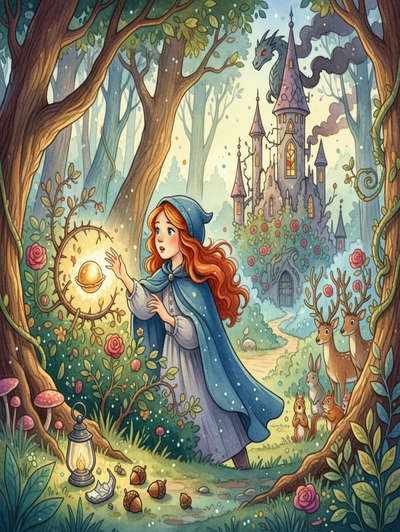
One day, a kind Fairy saw them. She liked their friendship. She left them flowers and sweets. Then, she showed herself to them. She smiled and spoke softly. The Fairy was magical and gentle. She wanted to help them. She cared for them deeply.
The Fairy had a magic fountain. It sparkled with water. She gave them a job. "Clean this fountain each morning," she said. "Do it before the sun rises. Do this, and you will be close." She promised them. The fountain was special to her. She trusted them. They said they would do it.
One morning, they saw many pretty flowers. "I will make Sylvain a garland," thought Jocosa. "How pretty Jocosa will look!" thought Sylvain. They picked many flowers for each other. They forgot the fountain. The sun came up. The fountain became a big, fast river. It was now between them. They could not cross it. The water flowed quickly. They called, but could not hear.
They walked by the river long. They felt very sad. They missed each other so much. They hoped to find a way across. But the river was wide and fast. Days passed, and they kept walking. They slept by the river at night. They felt alone and tired.
At last, they came to the sea. The river was wide. The kind Fairy saw them. She used her magic. They were close again on the sand. They hugged with joy. The Fairy smiled. They were finally reunited. They were so happy to see each other.
"We are sorry," they said. "We should have cleaned the fountain." "It is okay," said the Fairy. "I forgive you." They felt relieved. They thanked the Fairy.
"Your kin are friends now," said the Fairy. "I have a nice cottage for you. It is by the fountain. You can live there and be happy." She showed them the cottage. It was cozy and warm. They thanked her gratefully. They loved their new home.
The Fairy wanted to teach them a lesson. "Let me tell you a story," she said. "It is about a yellow bird. Listen carefully." They sat down to listen. They listened with care.
"A fairy became a yellow bird," said the Fairy. "She could make two people rich." It was a magical tale. They listened closely.
A bird catcher found the yellow bird. He sold it to a rich man. He wanted power and gold from the bird. He thought the bird was magical. He paid a lot of money for it. The bird catcher was happy with the sale.
The bird catcher's wife cooked the bird. She read the words on it carefully. She gave the head and heart to her sons. She knew it would help them. She kept it a secret. She was clever and kind.
The rich man was angry and sad. He gave up and went away. He lost his chance. He felt defeated. He was very upset.
The younger son got gold each day. But he spent it on toys and treats. He lost all his money. He became poor and sad. He had to work hard to survive. He learned that spending wisely is important. He had nothing left.
The older son became a leader. But he was mean to others. He forgot his kin. People were sad with his rule. He lost his job and was very sad. He had no friends left. He was all alone.
The Fairy finished her story. "Be happy with what you have," she said. "Wanting too much can make you sad. Always be content." They understood the lesson. They nodded their heads.
Sylvain and Jocosa promised to work hard. They got married. They lived in the cottage by the fountain. They were always happy. The Fairy loved them. "We will be faithful and happy," they said. And they lived with joy ever after. They smiled each day.
Original Story
_SYLVAIN AND JOCOSA_ Once upon a time there lived in the same village two children, one called Sylvain and the other Jocosa, who were both remarkable for beauty and intelligence. It happened that their parents were not on terms of friendship with one another, on account of some old quarrel, which had, however, taken place so long ago, that they had quite forgotten what it was all about, and only kept up the feud from force of habit. Sylvain and Jocosa for their parts were far from sharing this enmity, and indeed were never happy when apart. Day after day they fed their flocks of sheep together, and spent the long sunshiny hours in playing, or resting upon some shady bank. It happened one day that the Fairy of the Meadows passed by and saw them, and was so much attracted by their pretty faces and gentle manners that she took them under her protection, and the older they grew the dearer they became to her. At first she showed her interest by leaving in their favourite haunts many little gifts such as they delighted to offer one to the other, for they loved each other so much that their first thought was always, 'What will Jocosa like?' or, 'What will please Sylvain?' And the Fairy took a great delight in their innocent enjoyment of the cakes and sweetmeats she gave them nearly every day. When they were grown up she resolved to make herself known to them, and chose a time when they were sheltering from the noonday sun in the deep shade of a flowery hedgerow. They were startled at first by the sudden apparition of a tall and slender lady, dressed all in green, and crowned with a garland of flowers. But when she spoke to them sweetly, and told them how she had always loved them, and that it was she who had given them all the pretty things which it had so surprised them to find, they thanked her gratefully, and took pleasure in answering the questions she put to them. When she presently bade them farewell, she told them never to tell anyone else that they had seen her. 'You will often see me again,' added she, 'and I shall be with you frequently, even when you do not see me.' So saying she vanished, leaving them in a state of great wonder and excitement. After this she came often, and taught them numbers of things, and showed them many of the marvels of her beautiful kingdom, and at last one day she said to them, 'You know that I have always been kind to you; now I think it is time you did something for me in your turn. You both remember the fountain I call my favourite? Promise me that every morning before the sun rises you will go to it and clear away every stone that impedes its course, and every dead leaf or broken twig that sullies its clear waters. I shall take it as a proof of your gratitude to me if you neither forget nor delay this duty, and I promise that so long as the sun's earliest rays find my favourite spring the clearest and sweetest in all my meadows, you two shall not be parted from one another.' [Illustration] Sylvain and Jocosa willingly undertook this service, and indeed felt that it was but a very small thing in return for all that the fairy had given and promised to them. So for a long time the fountain was tended with the most scrupulous care, and was the clearest and prettiest in all the country round. But one morning in the spring, long before the sun rose, they were hastening towards it from opposite directions, when, tempted by the beauty of the myriads of gay flowers which grew thickly on all sides, they paused each to gather some for the other. 'I will make Sylvain a garland,' said Jocosa, and 'How pretty Jocosa will look in this crown!' thought Svlvain. Hither and thither they strayed, led ever farther and farther, for the brightest flowers seemed always just beyond them, until at last they were startled by the first bright rays of the rising sun. With one accord they turned and ran towards the fountain, reaching it at the same moment, though from opposite sides. But what was their horror to see its usually tranquil waters seething and bubbling, and even as they looked down rushed a mighty stream, which entirely engulfed it, and Sylvain and Jocosa found themselves parted by a wide and swiftly-rushing river. All this had happened with such rapidity that they had only time to utter a cry, and each to hold up to the other the flowers they had gathered; but this was explanation enough. Twenty times did Sylvain throw himself into the turbulent waters, hoping to be able to swim to the other side, but each time an irresistible force drove him back upon the bank he had just quitted, while, as for Jocosa, she even essayed to cross the flood upon a tree which came floating down torn up by the roots, but her efforts were equally useless. Then with heavy hearts they set out to follow the course of the stream, which had now grown so wide that it was only with difficulty they could distinguish each other. Night and day, over mountains and through valleys, in cold or in heat, they struggled on, enduring fatigue and hunger and every hardship, and consoled only by the hope of meeting once more--until three years had passed, and at last they stood upon the cliffs where the river flowed into the mighty sea. And now they seemed farther apart than ever, and in despair they tried once more to throw themselves into the foaming waves. But the Fairy of the Meadows, who had really never ceased to watch over them, did not intend that they should be drowned at last, so she hastily waved her wand, and immediately they found themselves standing side by side upon the golden sand. You may imagine their joy and delight when they realised that their weary struggle was ended, and their utter contentment as they clasped each other by the hand. They had so much to say that they hardly knew where to begin, but they agreed in blaming themselves bitterly for the negligence which had caused all their trouble; and when she heard this the Fairy immediately appeared to them. They threw themselves at her feet and implored her forgiveness, which she granted freely, and promised at the same time that now their punishment was ended she would always befriend them. Then she sent for her chariot of green rushes, ornamented with May dew-drops, which she particularly valued and always collected with great care; and ordered her six short-tailed moles to carry them all back to the well-known pastures, which they did in a remarkably short time; and Sylvain and Jocosa were overjoyed to see their dearly-loved home once more after all their toilful wanderings. The Fairy, who had set her mind upon securing their happiness, had in their absence quite made up the quarrel between their parents, and gained their consent to the marriage of the faithful lovers; and now she conducted them to the most charming little cottage that can be imagined, close to the fountain, which had once more resumed its peaceful aspect, and flowed gently down into the little brook which enclosed the garden and orchard and pasture which belonged to the cottage. Indeed, nothing more could have been thought of, either for Sylvain and Jocosa or for their flocks; and their delight satisfied even the Fairy who had planned it all to please them. When they had explored and admired until they were tired they sat down to rest under the rose-covered porch, and the Fairy said that to pass the time until the wedding guests whom she had invited could arrive she would tell them a story. This is it: The Yellow Bird Once upon a time a Fairy, who had somehow or other got into mischief, was condemned by the High Court of Fairyland to live for several years under the form of some creature, and at the moment of resuming her natural appearance once again to make the fortune of two men. It was left to her to choose what form she would take, and because she loved yellow she transformed herself into a lovely bird with shining golden feathers such as no one had ever seen before. When the time of her punishment was at an end the beautiful yellow bird flew to Bagdad, and let herself be caught by a Fowler at the precise moment when Badi-al-Zaman was walking up and down outside his magnificent summer palace. This Badi-al-Zaman--whose name means 'Wonder-of-the-World'--was looked upon in Bagdad as the most fortunate creature under the sun, because of his vast wealth. But really, what with anxiety about his riches and being weary of everything, and always desiring something he had not, he never knew a moment's real happiness. Even now he had come out of his palace, which was large and splendid enough for fifty kings, weary and cross because he could find nothing new to amuse him. The Fowler thought that this would be a favourable opportunity for offering him the marvellous bird, which he felt certain he would buy the instant he saw it. And he was not mistaken, for when Badi-al-Zaman took the lovely prisoner into his own hands, he saw written under its right wing the words, 'He who eats my head will become a king,' and under its left wing, 'He who eats my heart will find a hundred gold pieces under his pillow every morning.' In spite of all his wealth he at once began to desire the promised gold, and the bargain was soon completed. Then the difficulty arose as to how the bird was to be cooked; for among all his army of servants not one could Badi-al-Zaman trust. At last he asked the Fowler if he were married, and on hearing that he was he bade him take the bird home with him and tell his wife to cook it. [Illustration] 'Perhaps,' said he, 'this will give me an appetite, which I have not had for many a long day, and if so your wife shall have a hundred pieces of silver.' The Fowler with great joy ran home to his wife, who speedily made a savoury stew of the Yellow Bird. But when Badi-al-Zaman reached the cottage and began eagerly to search in the dish for its head and its heart he could not find either of them, and turned to the Fowler's wife in a furious rage. She was so terrified that she fell upon her knees before him and confessed that her two children had come in just before he arrived, and had so teased her for some of the dish she was preparing that she had presently given the head to one and the heart to the other, since these morsels are not generally much esteemed; and Badi-al-Zaman rushed from the cottage vowing vengeance against the whole family. The wrath of a rich man is generally to be feared, so the Fowler and his wife resolved to send their children out of harm's way; but the wife, to console her husband, confided to him that she had purposely given them the head and heart of the bird because she had been able to read what was written under its wings. So, believing that their children's fortunes were made, they embraced them and sent them forth, bidding them get as far away as possible, to take different roads, and to send news of their welfare. For themselves, they remained hidden and disguised in the town, which was really rather clever of them; but very soon afterwards Badi-al-Zaman died of vexation and annoyance at the loss of the promised treasure, and then they went back to their cottage to wait for news of their children. The younger, who had eaten the heart of the Yellow Bird, very soon found out what it had done for him, for each morning when he awoke he found a purse containing a hundred gold pieces under his pillow. But, as all poor people may remember for their consolation, nothing in the world causes so much trouble or requires so much care as a great treasure. Consequently, the Fowler's son, who spent with reckless profusion and was supposed to be possessed of a great hoard of gold, was before very long attacked by robbers, and in trying to defend himself was so badly wounded that he died. The elder brother, who had eaten the Yellow Bird's head, travelled a long way without meeting with any particular adventure, until at last he reached a large city in Asia, which was all in an uproar over the choosing of a new Emir. All the principal citizens had formed themselves into two parties, and it was not until after a prolonged squabble that they agreed that the person to whom the most singular thing happened should be Emir. Our young traveller entered the town at this juncture, with his agreeable face and jaunty air, and all at once felt something alight upon his head, which proved to be a snow-white pigeon. Thereupon all the people began to stare, and to run after him, so that he presently reached the palace with the pigeon upon his head and all the inhabitants of the city at his heels, and before he knew where he was they made him Emir, to his great astonishment. As there is nothing more agreeable than to command, and nothing to which people get accustomed more quickly, the young Emir soon felt quite at his ease in his new position; but this did not prevent him from making every kind of mistake, and so misgoverning the kingdom that at last the whole city rose in revolt and deprived him at once of his authority and his life--a punishment which he richly deserved, for in the days of his prosperity he disowned the Fowler and his wife, and allowed them to die in poverty. 'I have told you this story, my dear Sylvain and Jocosa,' added the Fairy, 'to prove to you that this little cottage and all that belongs to it is a gift more likely to bring you happiness and contentment than many things that would at first seem grander and more desirable. If you will faithfully promise me to till your fields and feed your flocks, and will keep your word better than you did before, I will see that you never lack anything that is really for your good.' Sylvain and Jocosa gave their faithful promise, and as they kept it they always enjoyed peace and prosperity. The Fairy had asked all their friends and neighbours to their wedding, which took place at once with great festivities and rejoicings, and they lived to a good old age, always loving one another with all their hearts. By the Comte de Caylus.
Moral of the Story
True happiness and lasting prosperity come from faithfulness, diligence, and contentment with what one has, rather than from fleeting desires or ill-gotten gains.
Characters

Sylvain ★ protagonist
Remarkable for beauty and intelligence
Attire: Simple shepherd's tunic and breeches, leather sandals
Loving, dutiful

Jocosa ★ protagonist
Remarkable for beauty and intelligence
Attire: Simple peasant dress, perhaps with an apron, bare feet
Loving, dutiful

Fairy of the Meadows ◆ supporting
Tall and slender
Attire: Dressed all in green, crowned with a garland of flowers
Kind, watchful

Badi-al-Zaman ○ minor
Wealthy, but weary and cross
Attire: Richly embroidered robes, jeweled turban
Greedy, discontent

Fowler ○ minor
Poor, but hopeful
Attire: Simple tunic and trousers
Opportunistic, easily led

Fowler's Wife ○ minor
Resourceful
Attire: Simple dress and apron
Protective, clever

Younger Son ○ minor
Reckless
Attire: Simple clothes
Reckless, wasteful

Elder Son ○ minor
Jaunty air
Attire: Simple clothes
Ambitious, ungrateful
Locations

Flowery Hedgerow
Deep shade, filled with flowers, a place to shelter from the noonday sun
Mood: Peaceful, magical, protected
The Fairy of the Meadows reveals herself to Sylvain and Jocosa.

Fairy's Favorite Fountain
Clear waters, stones impeding its course, dead leaves and broken twigs that sully the water
Mood: Tranquil, pure, then turbulent and chaotic
Sylvain and Jocosa fail their task, the fountain transforms into a wide river, separating them.

Cliffs by the Sea
Cliffs overlooking a mighty sea with foaming waves, golden sand
Mood: Desolate, despairing, then joyful and relieved
Sylvain and Jocosa are reunited by the Fairy of the Meadows.

Little Cottage
A simple cottage with fields to till and flocks to feed
Mood: Peaceful, content, prosperous
Sylvain and Jocosa promise to live a simple, faithful life.
Story DNA
Moral
True happiness and lasting prosperity come from faithfulness, diligence, and contentment with what one has, rather than from fleeting desires or ill-gotten gains.
Plot Summary
Childhood sweethearts Sylvain and Jocosa are tasked by the Fairy of the Meadows to diligently tend a magical fountain, promising they will never be parted if they do. One morning, distracted by gathering flowers for each other, they neglect their duty, and the fountain overflows into a raging river, separating them for three years of hardship. Reunited by the Fairy, they confess their fault, and she, having reconciled their parents, offers them a simple, happy life. To reinforce the lesson, she tells them a cautionary tale of two brothers who gain immense but ultimately destructive fortunes from a magical Yellow Bird, highlighting that true contentment comes from faithfulness and diligence, not greed.
Themes
Emotional Arc
innocence to suffering to wisdom and contentment
Writing Style
Narrative Elements
Cultural Context
Andrew Lang's collections often drew from various European and global folk traditions, and this specific tale is attributed to Comte de Caylus, a French writer of the 18th century, known for his 'Contes Orientaux' (Oriental Tales), which explains the Arabian elements in the nested story.
Plot Beats (17)
- Sylvain and Jocosa, two children from feuding families, are close friends and tend their flocks together.
- The Fairy of the Meadows, charmed by them, secretly leaves them gifts and later reveals herself, taking them under her protection.
- The Fairy tasks them with clearing her favorite fountain every morning before sunrise, promising they will never be parted if they fulfill this duty.
- One morning, distracted by gathering flowers for each other, they neglect the fountain, and it transforms into a wide, swift river, separating them.
- They spend three years following the river's course, enduring hardships and longing for reunion.
- Upon reaching the sea, the Fairy intervenes, reuniting them on the shore.
- Sylvain and Jocosa express remorse for their negligence, and the Fairy forgives them.
- The Fairy reveals she has reconciled their parents and prepared a charming cottage for them near the restored fountain.
- To emphasize the value of their new life, the Fairy tells them the story of the Yellow Bird.
- A mischievous Fairy, punished as a yellow bird, is destined to make the fortune of two men upon her return to human form.
- The bird is caught by a fowler and sold to the wealthy Badi-al-Zaman, who desires the kingly power from its head and daily gold from its heart.
- The fowler's wife, tasked with cooking the bird, secretly gives its head and heart to her two sons, having read the inscriptions.
- Badi-al-Zaman dies of vexation when he discovers the bird's parts are missing.
- The younger son, who ate the heart, receives daily gold but is robbed and killed due to his reckless spending.
- The elder son, who ate the head, becomes an Emir but misgoverns, disowns his parents, and is eventually overthrown and killed.
- The Fairy concludes her story, explaining that the simple cottage and diligent life are more valuable than grander, but ultimately destructive, fortunes.
- Sylvain and Jocosa promise to be faithful and diligent, marry, and live happily ever after, always loved by the Fairy.