Habogi
by Andrew Lang

Helga and Hábogi
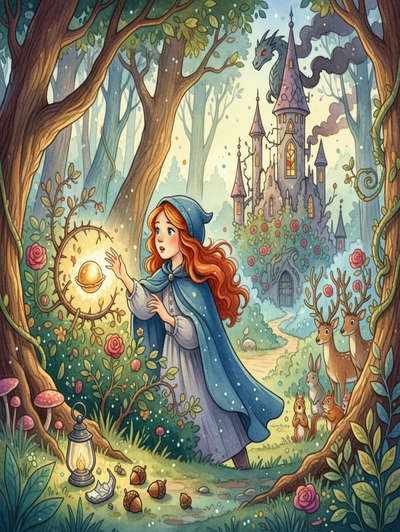
Once, there was a girl named Helga. She wanted to marry only Hábogi.
Many young men came to see Helga. She said no to all of them. She only wanted Hábogi.
Helga's sisters chose their husbands. They were very happy. They planned a big wedding.
On the wedding day, an old man came. His name was Hábogi. He declared Helga his wife. She was surprised. But she went with him.
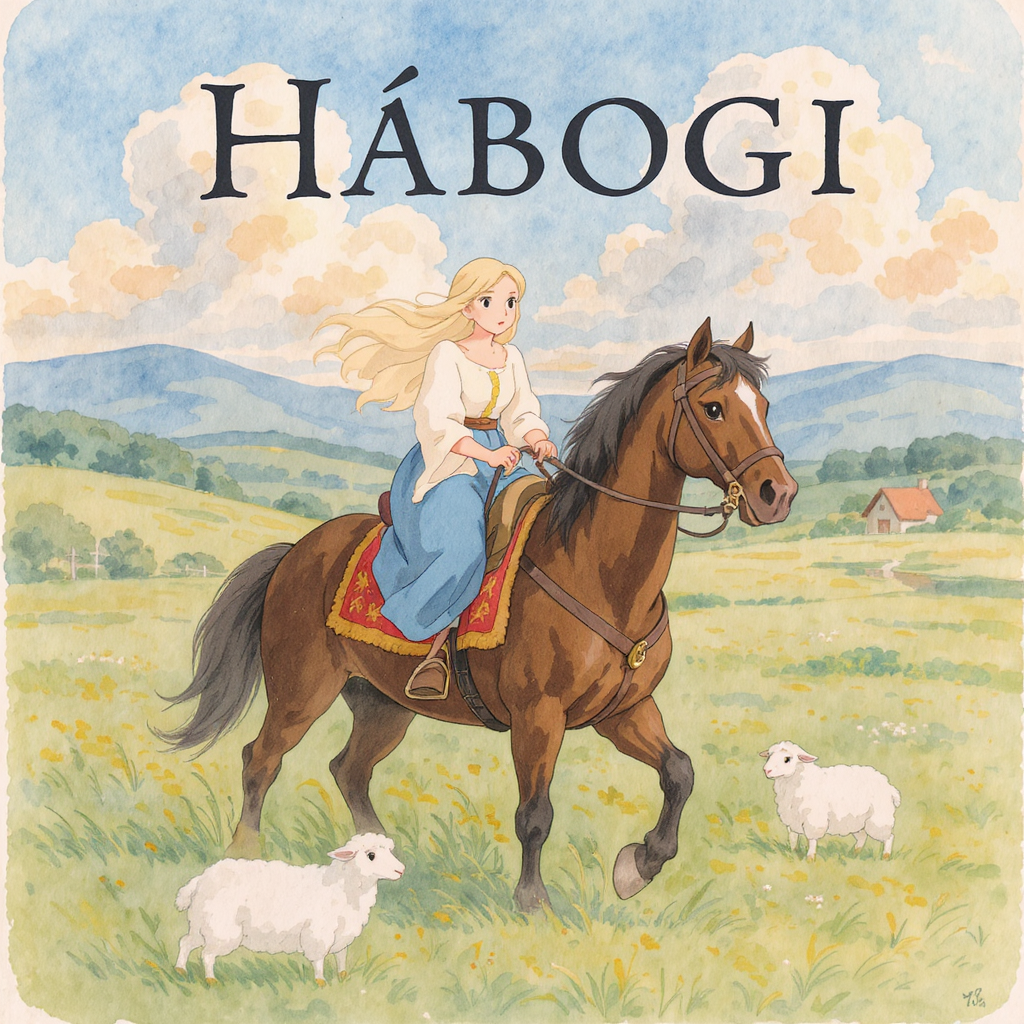
Hábogi put Helga on a big horse. They went for a ride. Helga wondered.
Hábogi showed Helga many pets. He had many sheep. He had many cows. He had many horses. "You can have the best ones," he said.
They came to a small, old house. The outside looked poor. But the inside was very pretty. It had soft carpets and shiny things.
Hábogi said, "Go home now. Come with kin soon." Helga went.
Helga's kin was glad she was safe. Her sisters heard about the pretty pets. They felt a little sad. They wished they had nice things too.
Soon, all went to Hábogi's house. The sisters saw the old outside. They felt happy. Then they saw the pretty inside. They felt jealous.
Helga had a pretty wedding dress. It shone like the sun. The sisters felt very jealous. They wanted to make it dirty.
The sisters spilled on the dress. They felt sorry right away. "We are sorry, Helga!" they said.
Hábogi used magic. He made the dress clean and shiny again. He smiled kindly. "It is okay," he said. The sisters learned to be happy for Helga.
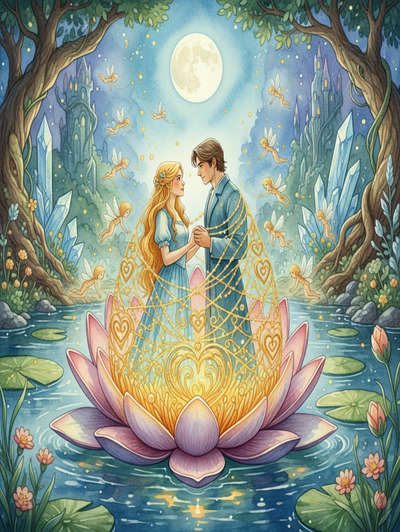
The next morning, the old house was gone. A big, pretty palace stood there. Hábogi looked young and handsome. He wore a blue coat and gold crown.
"That is my Hábogi," said Helga. They got married. All were happy and cheered.
The sisters said they were sorry. Helga forgave them. They all became friends.
Helga learned that true beauty is inside. Being kind is more important than looks.
Original Story
Hábogi.” The girl had never heard of such a name, and did not like it, so she determined to pay no attention; but as she opened her mouth to tell her father that her husband must be called Njal, she found herself answering instead: “If I do marry it will be to no one except Hábogi.” “Who IS Hábogi?” asked her father and sisters; “We never heard of such a person.” “All I can tell you is that he will be my husband, if ever I have one,” returned Helga; and that was all she would say. Before very long the young men who lived in the neighbouring villages or on the sides of the mountains, had heard of this talk of the three girls, and Sigmunds and Sigurds in scores came to visit the little cottage. There were other young men too, who bore different names, though not one of them was called “Hábogi,” and these thought that they might perhaps gain the heart of the youngest. But though there was more than one “Njal” amongst them, Helga’s eyes seemed always turned another way. At length the two elder sisters made their choice from out of the Sigurds and the Sigmunds, and it was decided that both weddings should take place at the same time. Invitations were sent out to the friends and relations, and when, on the morning of the great day, they were all assembled, a rough, coarse old peasant left the crowd and came up to the brides’ father. “My name is Hábogi, and Helga must be my wife,” was all he said. And though Helga stood pale and trembling with surprise, she did not try to run away. “I cannot talk of such things just now,” answered the father, who could not bear the thought of giving his favourite daughter to this horrible old man, and hoped, by putting it off, that something might happen. But the sisters, who had always been rather jealous of Helga, were secretly pleased that their bridegrooms should outshine hers. When the feast was over, Hábogi led up a beautiful horse from a field where he had left it to graze, and bade Helga jump up on its splendid saddle, all embroidered in scarlet and gold. “You shall come back again,” said he; “but now you must see the house that you are to live in.” And though Helga was very unwilling to go, something inside her forced her to obey. The old man settled her comfortably, then sprang up in front of her as easily as if he had been a boy, and, shaking the reins, they were soon out of sight. After some miles they rode through a meadow with grass so green that Helga’s eyes felt quite dazzled; and feeding on the grass were a quantity of large fat sheep, with the curliest and whitest wool in the world. “What lovely sheep! whose are they?” cried Helga. “Your Hábogi’s,” answered he, “all that you see belongs to him; but the finest sheep in the whole herd, which has little golden bells hanging between its horns, you shall have for yourself.” This pleased Helga very much, for she had never had anything of her own; and she smiled quite happily as she thanked Hábogi for his present. They soon left the sheep behind them, and entered a large field with a river running through it, where a number of beautiful grey cows were standing by a gate waiting for a milk-maid to come and milk them. “Oh, what lovely cows!” cried Helga again; “I am sure their milk must be sweeter than any other cows. How I should like to have some! I wonder to whom they belong?” “To your Hábogi,” replied he; “and some day you shall have as much milk as you like, but we cannot stop now. Do you see that big grey one, with the silver bells between her horns? That is to be yours, and you can have her milked every morning the moment you wake.” And Helga’s eyes shone, and though she did not say anything, she thought that she would learn to milk the cow herself. A mile further on they came to a wide common, with short, springy turf, where horses of all colours, with skins of satin, were kicking up their heels in play. The sight of them so delighted Helga that she nearly sprang from her saddle with a shriek of joy. “Whose are they?” Oh! whose are they?” she asked. “How happy any man must be who is the master of such lovely creatures!” “They are your Hábogi’s,” replied he, “and the one which you think the most beautiful of all you shall have for yourself, and learn to ride him.” At this Helga quite forgot the sheep and the cow. “A horse of my own!” said she. “Oh, stop one moment, and let me see which I will choose. The white one? No. The chestnut? No. I think, after all, I like the coal-black one best, with the little white star on his forehead. Oh, do stop, just for a minute.” But Hábogi would not stop or listen. “When you are married you will have plenty of time to choose one,” was all he answered, and they rode on two or three miles further. At length Hábogi drew rein before a small house, very ugly and mean-looking, and that seemed on the point of tumbling to pieces. “This is my house, and is to be yours,” said Hábogi, as he jumped down and held out his arms to lift Helga from the horse. The girl’s heart sank a little, as she thought that the man who possessed such wonderful sheep, and cows, and horses, might have built himself a prettier place to live in; but she did not say so. And, taking her arm, he led her up the steps. But when she got inside, she stood quite bewildered at the beauty of all around her. None of her friends owned such things, not even the miller, who was the richest man she knew. There were carpets everywhere, thick and soft, and of deep rich colours; and the cushions were of silk, and made you sleepy even to look at them; and curious little figures in china were scattered about. Helga felt as if it would take her all her life to see everything properly, and it only seemed a second since she had entered the house, when Hábogi came up to her. “I must begin the preparations for our wedding at once,” he said; “but my foster-brother will take you home, as I promised. In three days he will bring you back here, with your parents and sisters, and any guests you may invite, in your company. By that time the feast will be ready.” Helga had so much to think about, that the ride home appeared very short. Her father and mother were delighted to see her, as they did not feel sure that so ugly and cross-looking a man as Hábogi might not have played her some cruel trick. And after they had given her some supper they begged her to tell them all she had done. But Helga only told them that they should see for themselves on the third day, when they would come to her wedding. It was very early in the morning when the party set out, and Helga’s two sisters grew green with envy as they passed the flocks of sheep, and cows, and horses, and heard that the best of each was given to Helga herself; but when they caught sight of the poor little house which was to be her home their hearts grew light again. “I should be ashamed of living in such a place,” whispered each to the other; and the eldest sister spoke of the carved stone over HER doorway, and the second boasted of the number of rooms SHE had. But the moment they went inside they were struck dumb with rage at the splendour of everything, and their faces grew white and cold with fury when they saw the dress which Hábogi had prepared for his bride—a dress that glittered like sunbeams dancing upon ice. “She SHALL not look so much finer than us,” they cried passionately to each other as soon as they were alone; and when night came they stole out of their rooms, and taking out the wedding-dress, they laid it in the ash-pit, and heaped ashes upon it. But Hábogi, who knew a little magic, and had guessed what they would do, changed the ashes into roses, and cast a spell over the sisters, so that they could not leave the spot for a whole day, and every one who passed by mocked at them. The next morning when they all awoke the ugly tumble-down house had disappeared, and in its place stood a splendid palace. The guests’ eyes sought in vain for the bridegroom, but could only see a handsome young man, with a coat of blue velvet and silver and a gold crown upon his head. “Who is that?” they asked Helga. “That is my Hábogi,” said she. [From Neuislandischem Volksmärchen.]
Moral of the Story
True worth and beauty often lie hidden beneath a plain exterior, and envy can lead to foolish and self-defeating actions.
Characters

Helga ★ protagonist
Not explicitly described, but implied to be beautiful enough to attract many suitors.
Attire: Simple peasant dress initially, later a wedding dress that glittered like sunbeams dancing upon ice.
Obedient, initially passive, but shows growing appreciation for beauty and luxury; ultimately kind and accepting.

Hábogi ★ protagonist
Initially described as a rough, coarse old peasant.
Attire: Rough, coarse peasant clothing initially; later, a coat of blue velvet and silver with a gold crown.
Mysterious, generous, magically powerful, transformative.

Father ◆ supporting
Not described.
Attire: Typical peasant clothing.
Protective, concerned for his daughter's happiness.

Elder Sister 1 ⚔ antagonist
Not described.
Attire: Festive peasant dress.
Jealous, envious, spiteful.

Elder Sister 2 ⚔ antagonist
Not described.
Attire: Festive peasant dress.
Jealous, envious, spiteful.
Locations

Little Cottage
A small, humble cottage where Helga lives with her father and sisters. It is located near neighboring villages and mountains.
Mood: Simple, ordinary, a place of family life.
Helga declares she will only marry Hábogi; the sisters' weddings are planned.

Meadow with Sheep
A lush green meadow with a large flock of fat sheep with curly white wool. One sheep has golden bells between its horns.
Mood: Peaceful, prosperous, a sign of wealth.
Hábogi shows Helga his wealth and promises her a special sheep.

Field with Cows
A wide field with a river running through it, where grey cows are standing by a gate, waiting to be milked. One cow has silver bells between her horns.
Mood: Tranquil, bountiful, another sign of wealth.
Hábogi shows Helga more of his wealth and promises her a special cow.

Common with Horses
A wide common with short, springy turf, where horses of all colors with satin skins are playing.
Mood: Joyful, energetic, a display of beauty and freedom.
Hábogi shows Helga his horses and promises her the most beautiful one.

Ugly Little House / Splendid Palace
Initially, a small, ugly, mean-looking house that seems on the point of tumbling to pieces. Later, it transforms into a splendid palace.
Mood: Initially, disappointing and humble; later, magnificent and magical.
Helga arrives at Hábogi's house, which is initially disappointing but later transforms into a palace; the wedding takes place.
Story DNA
Moral
True worth and beauty often lie hidden beneath a plain exterior, and envy can lead to foolish and self-defeating actions.
Plot Summary
Helga, the youngest of three sisters, inexplicably vows to marry only a man named Hábogi. On her sisters' wedding day, a rough, old peasant appears, claiming to be Hábogi, and takes Helga to his seemingly poor home. Along the way, he reveals vast, beautiful herds of animals, promising her the finest. Though his house appears dilapidated, its interior is splendid. Helga's envious sisters attempt to ruin her wedding dress, but Hábogi, using magic, transforms the dress and reveals his true form as a handsome prince and his home as a magnificent palace, marrying Helga and shaming her sisters.
Themes
Emotional Arc
reluctance to acceptance to joy
Writing Style
Narrative Elements
Cultural Context
Folk tales often reflect societal values, such as the importance of inner character over outward appearance, and the consequences of envy.
Plot Beats (15)
- Helga, the youngest sister, declares she will only marry a man named Hábogi, a name no one knows.
- Many suitors come for the sisters, but Helga rejects all who are not Hábogi.
- Helga's elder sisters choose their husbands, and a double wedding is planned.
- On the wedding day, a rough, old peasant named Hábogi appears and claims Helga.
- Hábogi takes a reluctant Helga on horseback to his home.
- During the journey, Hábogi shows Helga vast herds of beautiful sheep, cows, and horses, promising her the best of each.
- They arrive at a small, ugly, dilapidated house, but inside it is sumptuously furnished.
- Hábogi sends Helga home to invite her family and guests for the wedding feast in three days.
- Helga's family is relieved she is safe, and her sisters become envious upon hearing of her promised wealth.
- On the wedding day, Helga's sisters are initially pleased by the sight of Hábogi's poor house, but then enraged by the interior's splendor and Helga's magnificent wedding dress.
- The sisters secretly ruin Helga's wedding dress by throwing it in the ash-pit.
- Hábogi, using magic, transforms the ashes into roses and casts a spell on the sisters, trapping them.
- The next morning, Hábogi's house is revealed as a splendid palace, and Hábogi himself is transformed into a handsome young man.
- Helga recognizes her Hábogi, and they are married.
- The envious sisters are shamed and mocked by passersby.