What One Can Invent
by Hans Christian Andersen

The Young Storyteller and the Wise Old Woman
Once there was a young story man. He wanted to tell many stories. But he felt very sad. He thought all good stories were told. He could not think of new ones.
He felt very, very tired. Thinking of stories was hard. He felt sick from trying. "No new stories for me," he thought. He was very sad.
He knew a kind, wise old woman. She lived in a small house. He decided to visit her. He wanted her help.
The Wise Old Woman smiled. "The world has many stories," she said. "You must look with care. You must hear well. Stories are all around!"
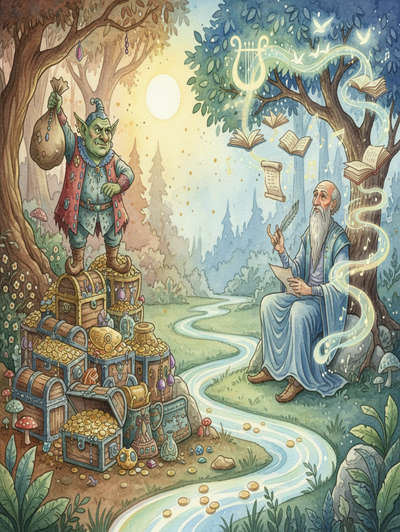
She gave him special glasses. She gave him a special ear-horn. "Use these to find stories," she said. "Think about the world. Do not just think of yourself."
The Young Story Man put them on. He held a big spud. He 'heard' its story. It grew deep in the earth. It came from far away. People learned to plant it. It was a good story!
Then he looked at the sloe bushes. He 'heard' their story. They
Original Story
What one can invent A fairy tale by Hans Christian Andersen There was once a young man who was studying to be a poet. He wanted to become one by Easter, and to marry, and to live by poetry. To write poems, he knew, only consists in being able to invent something; but he could not invent anything. He had been born too late– everything had been taken up before he came into the world, and everything had been written and told about. "Happy people who were born a thousand years ago!" said he. "It was an easy matter for them to become immortal. Happy even was he who was born a hundred years ago, for then there was still something about which a poem could be written. Now the world is written out, and what can I write poetry about?" Then he studied till he became ill and wretched, the wretched man! No doctor could help him, but perhaps the wise woman could. She lived in the little house by the wayside, where the gate is that she opened for those who rode and drove. But she could do more than unlock the gate. She was wiser than the doctor who drives in his own carriage and pays tax for his rank. "I must go to her," said the young man. The house in which she dwelt was small and neat, but dreary to behold, for there were no flowers near it– no trees. By the door stood a bee-hive, which was very useful. There was also a little potato-field, very useful, and an earth bank, with sloe bushes upon it, which had done blossoming, and now bore fruit, sloes, that draw one's mouth together if one tastes them before the frost has touched them. "That's a true picture of our poetryless time, that I see before me now," thought the young man; and that was at least a thought, a grain of gold that he found by the door of the wise woman. "Write that down!" said she. "Even crumbs are bread. I know why you come hither. You cannot invent anything, and yet you want to be a poet by Easter." "Everything has been written down," said he. "Our time is not the old time." "No," said the woman. "In the old time wise women were burnt, and poets went about with empty stomachs, and very much out at elbows. The present time is good, it is the best of times; but you have not the right way of looking at it. Your ear is not sharpened to hear, and I fancy you do not say the Lord's Prayer in the evening. There is plenty here to write poems about, and to tell of, for any one who knows the way. You can read it in the fruits of the earth, you can draw it from the flowing and the standing water; but you must understand how– you must understand how to catch a sunbeam. Now just you try my spectacles on, and put my ear-trumpet to your ear, and then pray to God, and leave off thinking of yourself" The last was a very difficult thing to do– more than a wise woman ought to ask. He received the spectacles and the ear-trumpet, and was posted in the middle of the potato-field. She put a great potato into his hand. Sounds came from within it; there came a song with words, the history of the potato, an every-day story in ten parts, an interesting story. And ten lines were enough to tell it in. And what did the potato sing? She sang of herself and of her family, of the arrival of the potato in Europe, of the misrepresentation to which she had been exposed before she was acknowledged, as she is now, to be a greater treasure than a lump of gold. "We were distributed, by the King's command, from the council-houses through the various towns, and proclamation was made of our great value; but no one believed in it, or even understood how to plant us. One man dug a hole in the earth and threw in his whole bushel of potatoes; another put one potato here and another there in the ground, and expected that each was to come up a perfect tree, from which he might shake down potatoes. And they certainly grew, and produced flowers and green watery fruit, but it all withered away. Nobody thought of what was in the ground– the blessing– the potato. Yes, we have endured and suffered, that is to say, our forefathers have; they and we, it is all one. "What a story it was! "Well, and that will do," said the woman. "Now look at the sloe bush." "We have also some near relations in the home of the potatoes, but higher towards the north than they grew," said the Sloes. "There were Northmen, from Norway, who steered westward through mist and storm to an unknown land, where, behind ice and snow, they found plants and green meadows, and bushes with blue-black grapes– sloe bushes. The grapes were ripened by the frost just as we are. And they called the land 'Wine-land,' that is, 'Groenland,' or 'Sloeland.' " "That is quite a romantic story," said the young man. "Yes, certainly. But now come with me," said the wise woman, and she led him to the bee-hive. He looked into it. What life and labor! There were bees standing in all the passages, waving their wings, so that a wholesome draught of air might blow through the great manufactory; that was their business. Then there came in bees from without, who had been born with little baskets on their feet; they brought flower-dust, which was poured out, sorted, and manufactured into honey and wax. They flew in and out. The queen-bee wanted to fly out, but then all the other bees must have gone with her. It was not yet the time for that, but still she wanted to fly out; so the others bit off her majesty's wings, and she had to stay where she was. "Now get upon the earth bank," said the wise woman. "Come and look out over the highway, where you can see the people." "What a crowd it is!" said the young man. "One story after another. It whirls and whirls! It's quite a confusion before my eyes. I shall go out at the back." "No, go straight forward," said the woman. "Go straight into the crowd of people; look at them in the right way. Have an ear to hear and the right heart to feel, and you will soon invent something. But, before you go away, you must give me my spectacles and my ear-trumpet again." And so saying, she took both from him. "Now I do not see the smallest thing," said the young man, "and now I don't hear anything more." "Why, then, you can't be a poet by Easter," said the wise woman. "But, by what time can I be one?" asked he. "Neither by Easter nor by Whitsuntide! You will not learn how to invent anything." "What must I do to earn my bread by poetry?" "You can do that before Shrove Tuesday. Hunt the poets! Kill their writings and thus you will kill them. Don't be put out of countenance. Strike at them boldly, and you'll have carnival cake, on which you can support yourself and your wife too." "What one can invent!" cried the young man. And so he hit out boldly at every second poet, because he could not be a poet himself. We have it from the wise woman. She knows What One Can Invent. * * * * *
Moral of the Story
True creativity comes from observing the world with an open mind and heart, not from seeking novelty for its own sake.
Characters

The Young Man ★ protagonist
Ill and wretched from overstudying
Attire: Simple, worn clothing appropriate for a student in 19th century Denmark
Ambitious, insecure, envious

The Wise Woman ◆ supporting
Implied to be weathered and knowing
Attire: Simple, practical clothing of a rural woman in 19th century Denmark
Wise, insightful, pragmatic

The Potato ◆ supporting
A large, earthy potato
Humble, informative, historical

The Sloes ◆ supporting
Blue-black berries on a thorny bush
Romantic, historical, connected to nature

The Queen-Bee ○ minor
Larger than the other bees
Regal, ambitious, constrained
Locations

Wise Woman's House
Small and neat, but dreary, with no flowers or trees nearby.
Mood: austere, practical
The young man seeks advice and receives magical items to perceive stories in nature.

Potato Field
A field of potato plants
Mood: ordinary, mundane, potentially insightful
The young man uses the spectacles and ear-trumpet to hear the potato's story.

Bee-hive
A busy bee-hive with bees flying in and out.
Mood: industrious, organized
The young man observes the bees and their complex society.

Highway
A crowded highway with many people passing by.
Mood: chaotic, overwhelming
The wise woman instructs the young man to observe the people and find stories within them.
Story DNA
Moral
True creativity comes from observing the world with an open mind and heart, not from seeking novelty for its own sake.
Plot Summary
A young man aspiring to be a poet is frustrated, believing all stories have been told. He consults a wise woman who gives him magical spectacles and an ear-trumpet, allowing him to perceive the rich, untold histories within everyday objects like a potato, sloe bushes, and a beehive. After observing humanity's endless stories, the woman takes back her tools, revealing that true invention comes from within. Unable to create without external aid, the young man cynically embraces her final advice to become a literary critic, attacking others' work to make a living.
Themes
Emotional Arc
frustration to enlightenment to cynical resignation
Writing Style
Narrative Elements
Cultural Context
Andersen often critiqued contemporary society and art. This story reflects a common concern of artists feeling that all originality has been exhausted, a sentiment particularly relevant in the Romantic and post-Romantic eras. The ending is a satirical jab at literary critics who may lack creative talent themselves.
Plot Beats (13)
- A young man wants to be a poet by Easter but feels everything has already been written.
- He laments his late birth and inability to invent, becoming ill from his frustration.
- He seeks help from a wise woman living by the roadside.
- The wise woman dismisses his complaints, stating his perception is the problem, not the lack of stories.
- She gives him magical spectacles and an ear-trumpet, instructing him to pray and stop thinking of himself.
- He 'hears' the detailed history and struggles of a potato, finding it a compelling story.
- He then 'hears' the romantic tale of sloe bushes and their connection to Viking exploration.
- He observes the industrious life within a beehive, witnessing its complex social structure and labor.
- He is then directed to observe the people on the highway, finding an overwhelming 'confusion' of stories.
- The wise woman takes back her tools, stating he cannot be a poet if he relies on external aids.
- The young man asks when he can be a poet, and she tells him 'never' if he can't invent.
- She cynically advises him to become a critic, attacking other poets to earn a living.
- The young man embraces this advice, becoming a harsh critic of other poets.