The Story of a Mother
by Hans Christian Andersen

The Loving Mother and the Quiet Man
Once, a mother loved her child so much.
The Loving Mother sat by her Little Child. She was very sad. Her child was pale and very still.
A Quiet Man came in. He was old. The Loving Mother slept. The Quiet Man carried the Little Child. He took the child to sleep.
The Loving Mother ran outside. Her child was gone. She saw Ms. Night. Ms. Night asked for a soft song. The Loving Mother sang her sad songs.
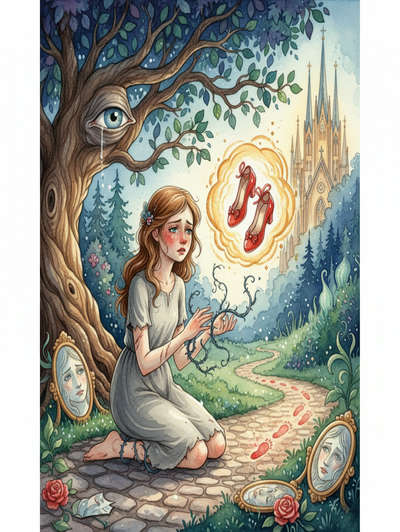
The Loving Mother found Mr. Bush. He was cold. She gave him her warmth. Mr. Bush felt warm. He showed her the way.
She came to Mr. Lake. He was big and wide. The Loving Mother closed her eyes. She trusted Mr. Lake. Mr. Lake carried her across.
She cannot see. She feels her way. She came to a special garden. It was The Quiet Man's garden. A kind Garden Lady was there.
The Loving Mother had beautiful hair. She gave her hair to the Garden Lady. This was a gift for help. The Garden Lady would help.
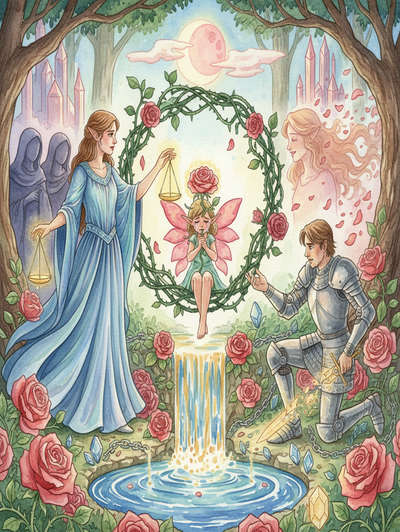
Many flowers grew there. Each flower was a life. The Loving Mother found her child's flower. It was small and weak.
The Quiet Man came. The Loving Mother held the flower. She wanted to protect it. His gentle breath made her hands soft.
The Quiet Man showed her two pictures. They were pictures of the future. Two flowers had two futures. One flower was her child's.
One picture showed smiles and sunshine. The other showed tears and clouds. The Loving Mother did not know. The Quiet Man would not tell her.
She felt a deep sadness. She whispered to the Quiet Man. "Please, let the sad life go. Let my child be peaceful. Let my child sleep."
The Quiet Man looked gently. "Do you want your child back?" he asked. "Or go to a peaceful sleep?"
The Loving Mother knelt down. She said, "Let what is meant to be. I trust in what is right. This is the best way."
The Quiet Man carried her Little Child. He took the child to a quiet place. She felt peace in her heart.
Original Story
The story of a mother A fairy tale by Hans Christian Andersen A mother sat by her little child; she was very sad, for she feared it would die. It was quite pale, and its little eyes were closed, and sometimes it drew a heavy deep breath, almost like a sigh; and then the mother gazed more sadly than ever on the poor little creature. Some one knocked at the door, and a poor old man walked in. He was wrapped in something that looked like a great horse-cloth; and he required it truly to keep him warm, for it was cold winter; the country everywhere lay covered with snow and ice, and the wind blew so sharply that it cut one's face. The little child had dozed off to sleep for a moment, and the mother, seeing that the old man shivered with the cold, rose and placed a small mug of beer on the stove to warm for him. The old man sat and rocked the cradle; and the mother seated herself on a chair near him, and looked at her sick child who still breathed heavily, and took hold of its little hand. "You think I shall keep him, do you not?" she said. "Our all-merciful God will surely not take him away from me." The old man, who was indeed Death himself, nodded his head in a peculiar manner, which might have signified either Yes, or No; and the mother cast down her eyes, while the tears rolled down her cheeks. Then her head became heavy, for she had not closed her eyes for three days and nights, and she slept, but only for a moment. Shivering with cold, she started up and looked round the room. The old man was gone, and her child– it was gone too!– the old man had taken it with him. In the corner of the room the old clock began to strike; "whirr" went the chains, the heavy weight sank to the ground, and the clock stopped; and the poor mother rushed out of the house calling for her child. Out in the snow sat a woman in long black garments, and she said to the mother, "Death has been with you in your room. I saw him hastening away with your little child; he strides faster than the wind, and never brings back what he has taken away." "Only tell me which way he has gone," said the mother; "tell me the way, I will find him." "I know the way," said the woman in the black garments; "but before I tell you, you must sing to me all the songs that you have sung to your child; I love these songs, I have heard them before. I am Night, and I saw your tears flow as you sang." "I will sing them all to you," said the mother; "but do not detain me now. I must overtake him, and find my child." But Night sat silent and still. Then the mother wept and sang, and wrung her hands. And there were many songs, and yet even more tears; till at length Night said, "Go to the right, into the dark forest of fir-trees; for I saw Death take that road with your little child." Within the wood the mother came to cross roads, and she knew not which to take. Just by stood a thorn-bush; it had neither leaf nor flower, for it was the cold winter time, and icicles hung on the branches. "Have you not seen Death go by, with my little child?" she asked. "Yes," replied the thorn-bush; "but I will not tell you which way he has taken until you have warmed me in your bosom. I am freezing to death here, and turning to ice." Then she pressed the bramble to her bosom quite close, so that it might be thawed, and the thorns pierced her flesh, and great drops of blood flowed; but the bramble shot forth fresh green leaves, and they became flowers on the cold winter's night, so warm is the heart of a sorrowing mother. Then the bramble-bush told her the path she must take. She came at length to a great lake, on which there was neither ship nor boat to be seen. The lake was not frozen sufficiently for her to pass over on the ice, nor was it open enough for her to wade through; and yet she must cross it, if she wished to find her child. Then she laid herself down to drink up the water of the lake, which was of course impossible for any human being to do; but the bereaved mother thought that perhaps a miracle might take place to help her. "You will never succeed in this," said the lake; "let us make an agreement together which will be better. I love to collect pearls, and your eyes are the purest I have ever seen. If you will weep those eyes away in tears into my waters, then I will take you to the large hothouse where Death dwells and rears flowers and trees, every one of which is a human life." "Oh, what would I not give to reach my child!" said the weeping mother; and as she still continued to weep, her eyes fell into the depths of the lake, and became two costly pearls. Then the lake lifted her up, and wafted her across to the opposite shore as if she were on a swing, where stood a wonderful building many miles in length. No one could tell whether it was a mountain covered with forests and full of caves, or whether it had been built. But the poor mother could not see, for she had wept her eyes into the lake. "Where shall I find Death, who went away with my little child?" she asked. "He has not arrived here yet," said an old gray-haired woman, who was walking about, and watering Death's hothouse. "How have you found your way here? and who helped you?" "God has helped me," she replied. "He is merciful; will you not be merciful too? Where shall I find my little child?" "I did not know the child," said the old woman; "and you are blind. Many flowers and trees have faded to-night, and Death will soon come to transplant them. You know already that every human being has a life-tree or a life-flower, just as may be ordained for him. They look like other plants; but they have hearts that beat. Children's hearts also beat: from that you may perhaps be able to recognize your child. But what will you give me, if I tell you what more you will have to do?" "I have nothing to give," said the afflicted mother; "but I would go to the ends of the earth for you." "I can give you nothing to do for me there," said the old woman; "but you can give me your long black hair. You know yourself that it is beautiful, and it pleases me. You can take my white hair in exchange, which will be something in return." "Do you ask nothing more than that?" said she. "I will give it to you with pleasure." And she gave up her beautiful hair, and received in return the white locks of the old woman. Then they went into Death's vast hothouse, where flowers and trees grew together in wonderful profusion. Blooming hyacinths, under glass bells, and peonies, like strong trees. There grew water-plants, some quite fresh, and others looking sickly, which had water-snakes twining round them, and black crabs clinging to their stems. There stood noble palm-trees, oaks, and plantains, and beneath them bloomed thyme and parsley. Each tree and flower had a name; each represented a human life, and belonged to men still living, some in China, others in Greenland, and in all parts of the world. Some large trees had been planted in little pots, so that they were cramped for room, and seemed about to burst the pot to pieces; while many weak little flowers were growing in rich soil, with moss all around them, carefully tended and cared for. The sorrowing mother bent over the little plants, and heard the human heart beating in each, and recognized the beatings of her child's heart among millions of others. "That is it," she cried, stretching out her hand towards a little crocus-flower which hung down its sickly head. "Do not touch the flower," exclaimed the old woman; "but place yourself here; and when Death comes– I expect him every minute– do not let him pull up that plant, but threaten him that if he does you will serve the other flowers in the same manner. This will make him afraid; for he must account to God for each of them. None can be uprooted, unless he receives permission to do so." There rushed through the hothouse a chill of icy coldness, and the blind mother felt that Death had arrived. "How did you find your way hither?" asked he; "how could you come here faster than I have?" "I am a mother," she answered. And Death stretched out his hand towards the delicate little flower; but she held her hands tightly round it, and held it fast at same time, with the most anxious care, lest she should touch one of the leaves. Then Death breathed upon her hands, and she felt his breath colder than the icy wind, and her hands sank down powerless. "You cannot prevail against me," said Death. "But a God of mercy can," said she. "I only do His will," replied Death. "I am his gardener. I take all His flowers and trees, and transplant them into the gardens of Paradise in an unknown land. How they flourish there, and what that garden resembles, I may not tell you." "Give me back my child," said the mother, weeping and imploring; and she seized two beautiful flowers in her hands, and cried to Death, "I will tear up all your flowers, for I am in despair." "Do not touch them," said Death. "You say you are unhappy; and would you make another mother as unhappy as yourself?" "Another mother!" cried the poor woman, setting the flowers free from her hands. "There are your eyes," said Death. "I fished them up out of the lake for you. They were shining brightly; but I knew not they were yours. Take them back– they are clearer now than before– and then look into the deep well which is close by here. I will tell you the names of the two flowers which you wished to pull up; and you will see the whole future of the human beings they represent, and what you were about to frustrate and destroy." Then she looked into the well; and it was a glorious sight to behold how one of them became a blessing to the world, and how much happiness and joy it spread around. But she saw that the life of the other was full of care and poverty, misery and woe. "Both are the will of God," said Death. "Which is the unhappy flower, and which is the blessed one?" she said. "That I may not tell you," said Death; "but thus far you may learn, that one of the two flowers represents your own child. It was the fate of your child that you saw,– the future of your own child." Then the mother screamed aloud with terror, "Which of them belongs to my child? Tell me that. Deliver the unhappy child. Release it from so much misery. Rather take it away. Take it to the kingdom of God. Forget my tears and my entreaties; forget all that I have said or done." "I do not understand you," said Death. "Will you have your child back? or shall I carry him away to a place that you do not know?" Then the mother wrung her hands, fell on her knees, and prayed to God, "Grant not my prayers, when they are contrary to Thy will, which at all times must be the best. Oh, hear them not;" and her head sank on her bosom. Then Death carried away her child to the unknown land. * * * * *
Moral of the Story
True love and faith mean accepting God's will, even when it involves profound suffering and loss.
Characters

The Mother ★ protagonist
Initially described as sad and weary, later blind and with white hair
Attire: Implied simple, practical clothing suitable for a mother in a cold climate; likely a long dress or skirt and shawl
Desperate, selfless, ultimately accepting

Death ⚔ antagonist
Wrapped in a large horse-cloth, cold
Attire: Large, dark horse-cloth
Impartial, dutiful, powerful

The Child ○ minor
Pale, with closed eyes
Attire: Not described
Innocent, vulnerable

Night ◆ supporting
Wears long black garments
Attire: Long, flowing black garments
Melancholy, demanding, observant

The Lake ◆ supporting
Vast, deep, filled with tears
Demanding, transactional

The Old Woman ◆ supporting
White hair, works in Death's hothouse
Attire: Simple, practical clothing for gardening
Helpful, mysterious, knowing

The Thorn-bush ◆ supporting
Barren, covered in icicles
Self-serving, demanding
Locations

Mother's Cottage
A small, humble room with a stove, a cradle, and an old clock. Cold winter air seeps in.
Mood: anxious, sorrowful, cold
Death first appears and takes the child.

Dark Fir Forest Crossroads
A snowy crossroads deep within a dark forest of fir trees. A bare thorn-bush stands nearby, covered in icicles.
Mood: desolate, cold, mysterious
The mother warms the thorn-bush with her blood in exchange for directions.

Vast Lake
A large, deep lake, partially frozen but not enough to cross. No boats are visible.
Mood: desperate, sorrowful, still
The mother sacrifices her eyes to cross the lake.

Death's Hothouse
An enormous building, resembling a mountain covered in forests and caves. Inside, flowers and trees grow in profusion, each representing a human life.
Mood: eerie, magical, poignant
The mother confronts Death and sees the future of her child.
Story DNA
Moral
True love and faith mean accepting God's will, even when it involves profound suffering and loss.
Plot Summary
A mother grieves for her dying child, who is then taken by Death, disguised as an old man. The mother embarks on a desperate journey, sacrificing her songs, blood, and eyes to allegorical figures (Night, a thorn-bush, a lake) to learn Death's path. She finally reaches Death's hothouse, where human lives are represented as flowers, and sacrifices her hair to identify her child's. After confronting Death and seeing glimpses of two possible futures—one blessed, one miserable—she prays for God's will to be done, leading Death to carry her child away to an unknown land.
Themes
Emotional Arc
suffering to acceptance
Writing Style
Narrative Elements
Cultural Context
Hans Christian Andersen's fairy tales often reflect a strong Christian worldview and themes of suffering, faith, and redemption, common in 19th-century Denmark.
Plot Beats (15)
- A mother sits by her gravely ill child, fearing its death.
- Death, disguised as an old man, enters their home and takes the child while the mother dozes.
- The mother rushes out, encountering Night, who demands her lullabies in exchange for Death's direction.
- She finds a thorn-bush and sacrifices her blood to warm it, receiving the next path.
- She reaches a lake and sacrifices her eyes, which become pearls, to be carried across.
- Blind, she arrives at Death's hothouse and encounters an old woman, Death's gardener.
- She sacrifices her beautiful hair for the old woman's white hair to gain access and help identifying her child's life-flower.
- She identifies her child's sickly crocus-flower among countless others.
- Death arrives, and the mother attempts to protect her child's flower, but Death's breath makes her hands powerless.
- The mother threatens to destroy other flowers, but Death shows her her eyes and offers her a glimpse into the future of two life-flowers, one of which is her child's.
- She sees one life of blessing and joy, and another of misery and woe, but Death refuses to tell her which is her child's.
- Terrified, she begs Death to take the unhappy child, even if it is hers, and to forget her previous pleas.
- Death expresses confusion, asking if she wants her child back or taken away.
- The mother, on her knees, prays for God's will to prevail, even if it contradicts her own desires.
- Death carries her child away to the unknown land.