THE IMPOSTOR
by Aesop

The Man Who Broke His Promise
Once, there was a man. He was very, very sick. He felt very bad. His body was weak and tired. He could not get up from his bed. He was very sad and worried.
The Man made a big promise. He spoke to the Sky Spirits. "Make me well again," he said. "I will give you one hundred oxen." It was a big promise. He had no oxen at all.
The Sky Spirits heard his promise. They wanted to see. Would he keep his word? Soon, the Man felt much better. He was strong and healthy again. He was not sick anymore.
The Man had no real oxen. He found some soft wax. He made one hundred small oxen. They were made of pale wax. He put them on a small altar. "My promise is now done," he said. He did not tell the truth.
The Sky Spirits saw his clever trick. They were not happy at all. He broke his big promise to them. They decided to teach him a lesson. He needed to learn about honesty.
The Man had a strange dream. A clear voice spoke to him. "Go to the sea," it said. "You will find a special treasure there. It is one hundred shining crowns." The Man felt happy.
The Man woke up quickly. He was very excited. He ran to the sea shore. He wanted the gold treasure. He thought he would be rich soon.
He walked by the ocean water. Some Bad Men saw him there. They jumped out from hiding. They grabbed him very quickly. The Man was scared and trapped.
The Bad Men took him far away. They made him work for them. He had to work for a long time. He had to pay a big debt. He worked hard every day.
The Bad Men said, "You owe us." He must earn one hundred crowns. This was the Sky Spirits' clever plan. He learned his hard lesson. He broke his first promise.
It is important to keep your promises. Do not promise things you cannot do.
Original Story
THE IMPOSTOR
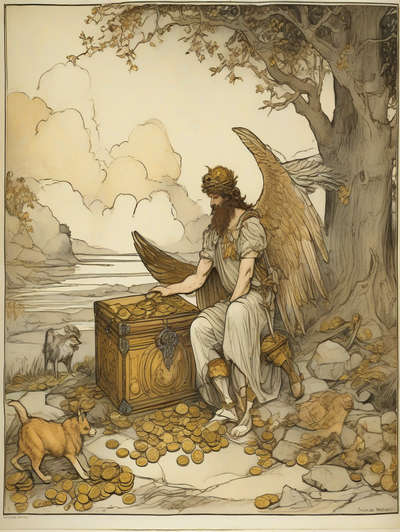
A certain man fell ill, and, being in a very bad way, he made a vow that he would sacrifice a hundred oxen to the gods if they would grant him a return to health. Wishing to see how he would keep his vow, they caused him to recover in a short time. Now, he hadn't an ox in the world, so he made a hundred little oxen out of tallow and offered them up on an altar, at the same time saying, "Ye gods, I call you to witness that I have discharged my vow." The gods determined to be even with him, so they sent him a dream, in which he was bidden to go to the sea-shore and fetch a hundred crowns which he was to find there. Hastening in great excitement to the shore, he fell in with a band of robbers, who seized him and carried him off to sell as a slave: and when they sold him a hundred crowns was the sum he fetched.
Do not promise more than you can perform.
---
Moral of the Story
Do not promise more than you can perform.
Characters

The Impostor ★ protagonist
Of average height and build, initially appearing frail due to illness but quickly regaining a robust, healthy appearance after his recovery. No specific distinguishing features are mentioned, suggesting a common man's look.
Attire: Simple, functional tunic and sandals typical of a common man in ancient Greece or Rome. After his recovery, perhaps slightly better but still modest clothing, reflecting his lack of wealth.
Wants: To avoid fulfilling his difficult vow while still appearing to honor it, and to gain wealth without effort.
Flaw: Greed, dishonesty, and a belief that he can outsmart divine powers without consequence.
He begins as a desperate, ill man who recovers. He then attempts to deceive the gods, believing he has succeeded, only to be tricked himself and reduced to slavery, learning the hard lesson that dishonesty has consequences.
Cunning, deceitful, opportunistic, quick-witted (in a self-serving way), and ultimately foolish. He is driven by self-preservation and a desire to avoid consequences.

The Gods ⚔ antagonist
Not physically described, as they act through intervention and dreams. They are implied to be all-seeing and powerful, capable of influencing human events.
Attire: Not applicable.
Wants: To ensure vows are honored and to punish those who attempt to deceive them.
Flaw: None explicitly stated; they appear omnipotent within the story's context.
They observe the man's vow, grant his recovery, witness his deceit, and then orchestrate his ironic punishment.
Observant, just (in their own way), retaliatory, and powerful. They do not tolerate deceit.

The Robbers ○ minor
A band of rough, strong men, likely hardened by their life of crime. No specific individual features are given, suggesting a generic group of brigands.
Attire: Practical, sturdy, and somewhat worn clothing suitable for travel and ambush, such as dark tunics, cloaks, and sturdy boots, possibly with crude weapons visible.
Wants: To capture and sell people for profit.
Flaw: None shown; they are effective in their role.
They serve as the instrument of the gods' retribution, appearing only to fulfill their role in the Impostor's downfall.
Ruthless, opportunistic, and driven by greed.
Locations

The Impostor's Home Altar
A humble, likely small and sparsely furnished room within the man's dwelling, where he sets up a makeshift altar to make his offering.
Mood: deceptive, slightly desperate, mock-pious
The man 'discharges' his vow by offering tallow oxen instead of real ones.

The Sea-shore
A coastal area, likely rocky or sandy, where the man eagerly goes to find his promised reward, only to encounter robbers.
Mood: initially hopeful and excited, quickly turning dangerous and desperate
The man, seeking his reward, is ambushed by robbers and taken captive.
Story DNA
Moral
Do not promise more than you can perform.
Plot Summary
A gravely ill man vows to sacrifice a hundred oxen to the gods if he recovers. Upon recovery, he deceptively offers a hundred tallow oxen instead. The gods, angered by his trickery, send him a dream to find a hundred crowns on the seashore. When he goes, he is captured by robbers and sold into slavery for exactly one hundred crowns, serving as divine retribution for his broken vow.
Themes
Emotional Arc
hope to despair
Writing Style
Narrative Elements
Cultural Context
Aesop's Fables are ancient Greek stories often featuring animals or humans, designed to teach moral lessons. Vows and sacrifices to deities were common practices in ancient Greek religion.
Plot Beats (10)
- A man falls gravely ill.
- He vows to sacrifice a hundred oxen to the gods if he recovers.
- The gods, curious, grant his recovery.
- The man, having no oxen, crafts a hundred tallow oxen and offers them, claiming to have fulfilled his vow.
- The gods, angered by his deceit, decide to retaliate.
- They send him a dream instructing him to go to the seashore to find a hundred crowns.
- Excited, the man rushes to the shore.
- He is ambushed by a band of robbers.
- The robbers capture him and sell him into slavery.
- He is sold for precisely one hundred crowns, serving as the gods' ironic punishment.